
- Client Duong Do dinh - (0986490xxx) bought 8 month ago (25/11/2025)
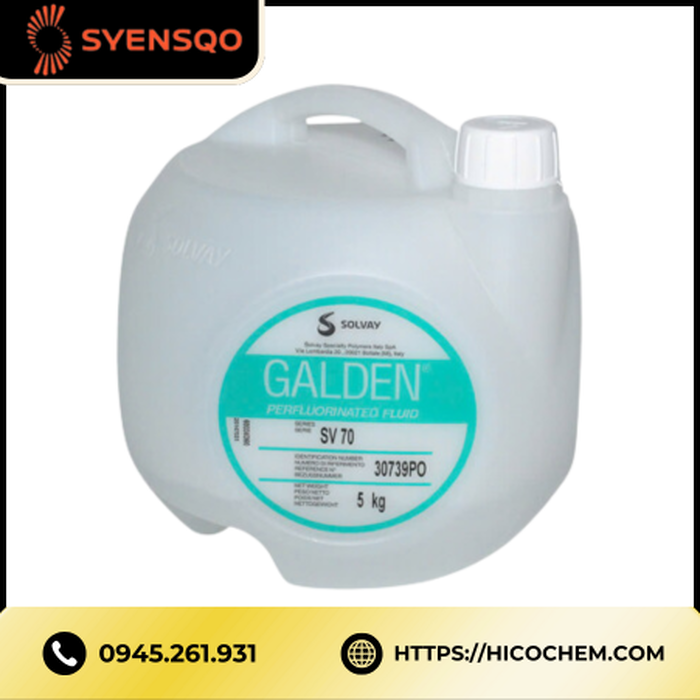
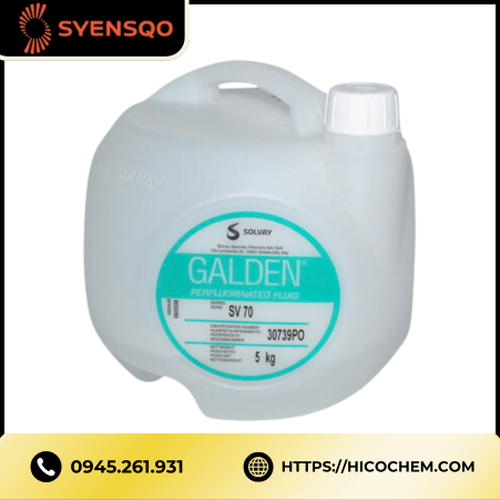
Galden SV 70
4 5 (1 evaluate)Category: Galden® SV
Maker: Syensqo
Made in: Italy
Packaging: 1kg, 5kg
What Is Galden® SV 70?
Galden® SV70 is a low-molecular-weight perfluoropolyether (PFPE) solvent developed for precision cleaning, degreasing, equipment flushing and fluorinated-lubricant processing. With a nominal boiling point of 70°C, low viscosity and relatively high vapor pressure, SV70 offers rapid evaporation while providing slightly more working time than Galden® SV55.
This performance profile makes Galden® SV70 particularly relevant to semiconductor facilities, electronics manufacturing plants, vacuum-system maintenance and industrial processes involving PFPE oils and greases. It may be used where engineers require fast drying, effective penetration into narrow equipment geometries and compatibility with fluorinated lubricants.
The product should not be regarded as a universal cleaner for every industrial contaminant. Its cleaning effectiveness depends on the chemical nature of the residue, exposure time, temperature, agitation, component geometry and final cleanliness requirement.
Key Features and Process Benefits
| Key feature | Practical benefit for plant engineers |
|---|---|
| Nominal boiling point of 70°C | Provides fast evaporation with slightly more cleaning time than SV55 |
| Vapor pressure of 141 torr at 20°C | Supports rapid drying and short maintenance cycles |
| Kinematic viscosity of 0.50 cSt at 25°C | Promotes circulation and penetration into narrow gaps, channels and cavities |
| Surface tension of 14 dyne/cm | Supports effective wetting of detailed surfaces and complex component geometries |
| Full miscibility with PFPE oils and greases | Enables removal, dilution and controlled application of fluorinated lubricants |
| Non-flammable behavior | Reduces ignition risk compared with many conventional hydrocarbon solvents |
| Dielectric properties | Supports validated cleaning of compatible electronic and electromechanical components |
| Water solubility below 10 ppm | Helps limit moisture introduction into sensitive industrial processes |
| Broad material compatibility | Suitable for many metals, plastics and elastomers after application-specific testing |
| Zero ozone-depletion potential | Contains no CFCs, chlorine, bromine or iodine associated with ozone depletion |
The combination of very low viscosity and low surface tension allows Galden® SV70 to spread rapidly across component surfaces and enter narrow internal passages. These properties can be valuable when cleaning pump channels, valve cavities, small mechanical assemblies and precision equipment that is difficult to access using more viscous fluids.
Its relatively high vapor pressure supports fast drying, but it can also increase evaporation losses in open systems. Process engineers should therefore consider enclosed cleaning tanks, covers, condensation zones, solvent-compatible seals and fluid-recovery systems when designing repeated-use operations.
Syensqo reports that Galden® PFPE fluids are compatible with commonly used metals, plastics and elastomers. However, the manufacturer also recommends testing the actual formulated materials because commercial seals, hoses, adhesives and polymers may contain fillers or additives that affect compatibility.
Technical Properties
The following values are typical properties published in the manufacturer’s Galden® SV technical literature. They are intended for product comparison and process evaluation, not as guaranteed purchasing specifications.
| Property | Unit | Typical value |
|---|---|---|
| Chemical base | — | PFPE |
| Boiling point | °C | 70 |
| Density | g/cm³ | 1.68 |
| Surface tension | dyne/cm | 14 |
| Kinematic viscosity at 25°C | cSt | 0.50 |
| Heat of vaporization at boiling point | cal/g | 17 |
| Vapor pressure at 20°C | torr | 141 |
| Water solubility | ppm | <10 |
| Flash point | °C | None reported |
| Fire point | °C | None reported |
| Autoignition temperature | °C | None reported |
| Ozone-depletion potential | — | 0 |
These properties position SV70 as a fast-evaporating grade. Its viscosity of 0.50 cSt supports easy flow and drainage, while its vapor pressure of 141 torr at 20°C enables relatively rapid solvent removal after cleaning.
QA/QC engineers should not convert these typical values directly into incoming-inspection limits. Product acceptance criteria should be based on the current Syensqo technical data sheet, safety data sheet, certificate of analysis and the factory’s validated process requirements.
Galden® SV Series Comparison
Boiling point, vapor pressure, viscosity and surface tension are the principal parameters used to compare the numbered Galden® SV grades. Lower-boiling products generally provide faster drying, whereas higher-boiling grades offer longer contact time and lower rapid evaporation.
| Grade | Boiling point | Density | Viscosity at 25°C | Surface tension | Vapor pressure at 20°C | General process profile |
|---|---|---|---|---|---|---|
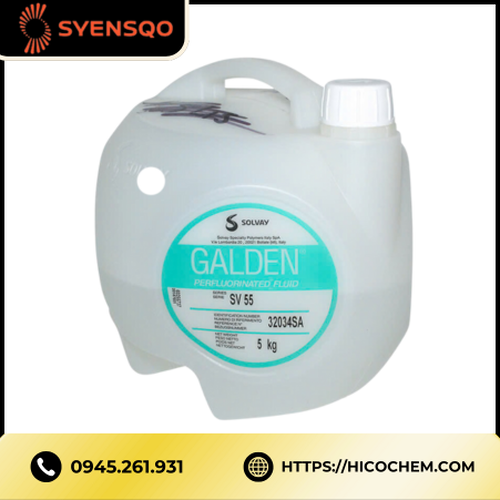
| Galden® SV55 | 55°C | 1.65 g/cm³ | 0.45 cSt | 14 dyne/cm | 228 torr | Fastest evaporation and shortest working time |
| Galden® SV70 | 70°C | 1.68 g/cm³ | 0.50 cSt | 14 dyne/cm | 141 torr | Fast drying with slightly longer contact time than SV55 |
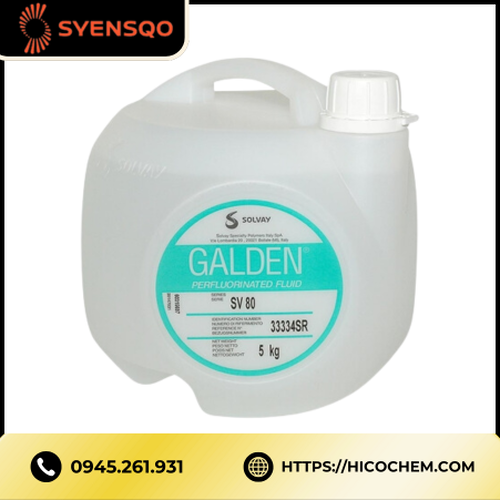
| Galden® SV80 | 80°C | 1.68 g/cm³ | 0.57 cSt | 16 dyne/cm | 62 torr | Balanced rapid drying and cleaning contact time |
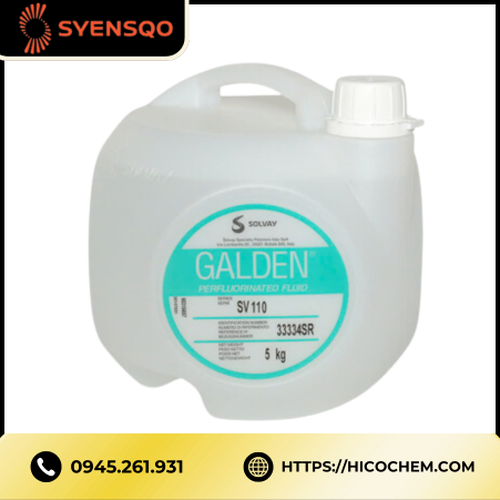
| Galden® SV110 | 110°C | 1.71 g/cm³ | 0.77 cSt | 16 dyne/cm | 17 torr | Controlled evaporation and medium-to-long working time |
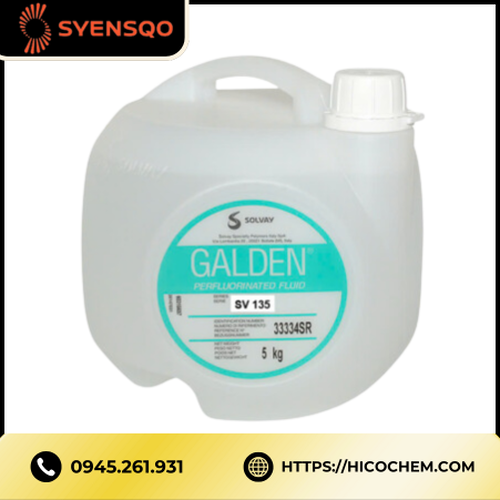
| Galden® SV135 | 135°C | 1.72 g/cm³ | 1.00 cSt | 17 dyne/cm | 8 torr | Slowest evaporation and longest contact time among the numbered grades |
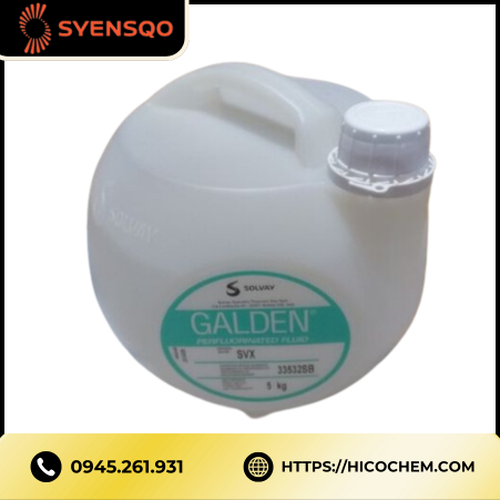
| Galden® SVX | Consult current TDS | Consult current TDS | Consult current TDS | Consult current TDS | Consult current TDS | Specialized dielectric and heat-transfer fluid; evaluate separately |
The numerical values for SV55, SV70, SV80, SV110 and SV135 are typical manufacturer data and are not specification limits. All numbered grades have reported water solubility below 10 ppm, zero ozone-depletion potential and no reported flash point, fire point or autoignition temperature.
Galden® SV70 is generally selected when SV55 evaporates too rapidly but the process still requires faster drying than SV80. It provides a practical option for short cleaning cycles, rapid flushing and applications where extended soaking is unnecessary.
Galden® SVX should not be considered a direct continuation of the numbered solvent range. Syensqo describes SVX as a high-performance inert PFPE fluid for heat-transfer and dielectric applications requiring thermal stability, chemical inertness and material compatibility. Its suitability should be assessed using its current product-specific technical documentation.
Common Applications
1. PFPE Oil and Grease Removal
Galden® SV70 can dissolve and flush compatible PFPE oil and grease residues from machine components, lubrication systems and maintenance tools. Its rapid evaporation supports short turnaround times after rinsing.
2. Vacuum-Pump Cleaning
SV70 may be used to clean compatible pump housings, valves, fittings, internal passages and other components contaminated with fluorinated lubricants. The equipment should be fully drained and dried before evacuation and recommissioning. Manufacturer literature identifies pump cleaning as a principal application of Galden® SV fluids.
3. Semiconductor Equipment Maintenance
The product can support precision cleaning of compatible semiconductor process-tool components where high purity, low moisture absorption, non-flammability and PFPE compatibility are required. Cleaning procedures should be qualified against particle, ionic and non-volatile-residue specifications.
4. Electronics and SMT Equipment Cleaning
SMT and electronics engineers may evaluate SV70 for cleaning compatible mechanical parts, sensors, actuators, nozzles or lubricant-handling components. However, SV70 should not automatically be treated as a universal solder-flux or assembled-PCB cleaner. Compatibility with the actual flux chemistry and component materials must be demonstrated.
5. PFPE Lubricant Dilution and Application
Because SV70 is fully miscible with PFPE oils and greases, it can be used as a carrier for diluted lubricant solutions applied by dipping, spraying or controlled dispensing. Process engineers should validate the lubricant concentration, deposited film thickness and solvent-evaporation stage.
6. Degreasing and Trace-Residue Removal
Manufacturer literature lists degreasing, vapor blanketing, improving the flash point of mixed-solvent systems and eliminating trace residues among the applications of Galden® SV fluids. Any mixed-solvent process requires formal chemical-compatibility and safety validation.
Frequently Asked Questions
1. Is Galden® SV70 flammable?
The manufacturer reports no flash point, fire point or autoignition temperature for SV70 and describes the Galden® SV range as non-flammable. Users must still follow the current safety data sheet and avoid excessive heating that could cause thermal decomposition.
2. What is the difference between SV70 and SV55?
SV70 has a higher boiling point and lower vapor pressure. It normally provides slightly more cleaning contact time and slower evaporation than SV55.
3. How does SV70 compare with SV80?
SV70 evaporates faster because its vapor pressure at 20°C is 141 torr, compared with 62 torr for SV80. SV80 generally provides longer wetting time and lower rapid evaporation.
4. Can SV70 remove PFPE grease?
Yes. Galden® SV fluids are fully miscible with PFPE oils and greases. Actual cleaning performance depends on grease consistency, contamination thickness, agitation, temperature and exposure time.
5. Is SV70 suitable for solder-flux cleaning?
Not necessarily. Its primary strength is compatibility with fluorinated oils and greases. The actual solder flux should be tested because some fluxes may require a different solvent or a qualified co-solvent system.
6. Does Galden® SV70 leave residue?
The base fluid is high-purity and volatile. However, dissolved contamination may remain if the component is not properly rinsed, drained or dried. Final cleanliness should be verified using appropriate QA/QC methods.
7. Can SV70 be used on plastics and elastomers?
Syensqo reports broad material compatibility, but actual formulated seals, adhesives and polymers should be tested for swelling, cracking, softening or dimensional change before production use.
8. Why select SV70 instead of a higher-boiling grade?
SV70 is appropriate when rapid drying and short process cycles are more important than extended solvent contact time. SV110 or SV135 may be more suitable for soaking or slow-evaporation processes.
9. How should Galden® SV70 be stored and handled?
Store the product in its original sealed container and protect it from moisture, particles and incompatible chemicals. Ventilation, personal protective equipment, transfer methods and waste handling must follow the latest Syensqo safety data sheet and applicable local regulations.

AAdministratorsQTV
Welcome. Feel free to leave a comment, we will respond soon