
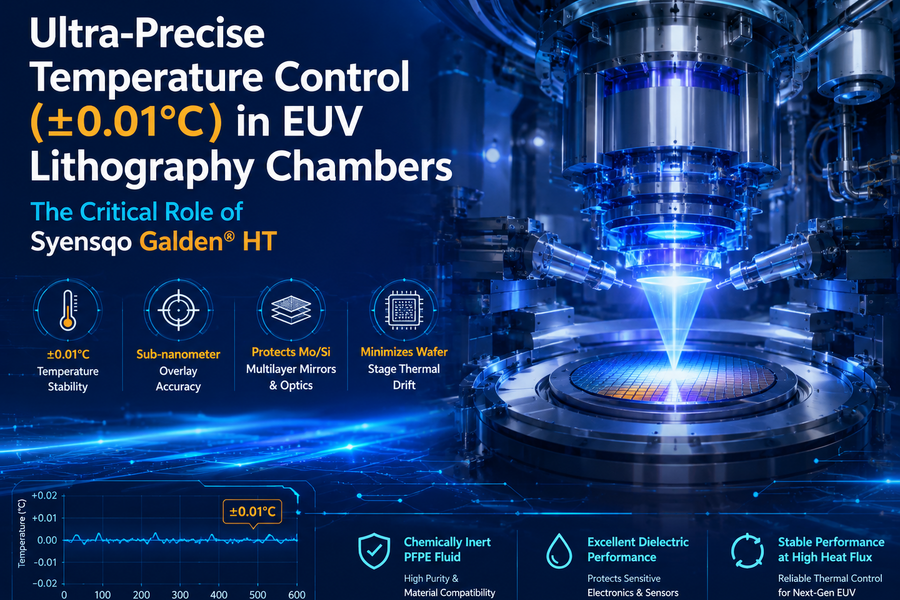
1. EUV Lithography and the Sub-Nanometer Thermal Problem
Extreme ultraviolet lithography uses 13.5 nm radiation and reflective optics operating under vacuum. Unlike conventional optical systems, EUV scanners cannot rely on ordinary transmissive lenses because most materials strongly absorb EUV radiation.
Instead, the optical system uses precision multilayer reflective optics, including Mo/Si multilayer mirrors. These structures must maintain extremely precise geometry and surface characteristics to preserve the EUV wavefront.
The thermal-control problem can therefore be expressed as:
EUV energy absorption → heat generation → temperature gradient → thermo-mechanical deformation → optical/stage displacement → imaging and overlay error.
Even small temperature variations can become significant when equipment operates with nanometer-scale positioning requirements.
For a component of length L, thermal expansion can be approximated by:
ΔL ≈ αLΔT
where α is the effective coefficient of thermal expansion (CTE).
For example, a hypothetical 100 mm structure with an effective CTE of 1 × 10⁻⁶/K would experience approximately 1 nm of dimensional change for a 0.01°C temperature excursion.
This is a simplified illustration rather than an overlay specification. Actual EUV systems use low-CTE materials, mechanical constraints, interferometric metrology, thermal modeling, and correction algorithms.
The key point is that thermal stability directly contributes to maintaining the available overlay budget.
2. Why Thermal Stability Matters for EUV Optical Components
Mo/Si Multilayer Mirror Stability
EUV mirrors typically use alternating layers of molybdenum and silicon to achieve high reflectivity at 13.5 nm.
When the mirror temperature changes, the multilayer structure and substrate can undergo thermo-elastic deformation. The resulting dimensional changes can affect:
-
Multilayer spacing
-
Mirror figure
-
Surface curvature
-
Wavefront accuracy
-
Focal position
-
Imaging performance
The most important variable is not simply the average mirror temperature. Spatial temperature uniformity is equally important.
A mirror at a stable average temperature can still experience local distortion if one region is warmer than another.
Therefore, precision thermal management must control:
ΔT, ∇T, and dT/dt
where:
-
ΔT = temperature variation
-
∇T = spatial temperature gradient
-
dT/dt = rate of temperature change
These three parameters collectively describe the thermal stability required to minimize thermo-mechanical drift.
3. Galden® HT as a Precision Thermal-Management Medium
Syensqo Galden® HT PFPE is an inert, dielectric, high-performance heat-transfer-fluid family used in semiconductor and electronics thermal-management systems.
Its key properties include:
-
PFPE / Perfluoropolyether chemistry
-
High chemical and thermal stability
-
Low evaporation losses
-
Low viscosity
-
High dielectric strength
-
High electrical resistivity
-
Non-flammability
-
Compatibility with many metals, plastics, and elastomers
-
Broad operating-temperature capability
These properties are particularly valuable around equipment containing sensors, electrical connections, electrostatic systems, and other sensitive components.
Why viscosity matters
Kinematic viscosity directly influences pumpability, pressure drop, and heat-transfer performance.
Galden® HT grades are available across different viscosity and boiling-point ranges. Therefore, fluid selection must consider both:
Thermal requirement + hydraulic requirement
rather than selecting a grade solely by boiling point.
4. Wafer-Stage Thermal Stabilization
The wafer stage must simultaneously provide high-speed movement, nanometer-level positioning, and stable mechanical geometry.
Its thermal load can originate from:
-
EUV exposure
-
Stage motors and actuators
-
Electrostatic chuck operation
-
Sensors and electronics
-
Heat transfer surrounding structures
Temperature gradients can produce differential expansion of the stage, chuck, wafer, and supporting structures.
For a silicon wafer:
ΔL ≈ αLΔT
where:
-
ΔL = change in wafer dimension
-
α = coefficient of thermal expansion (CTE)
-
L = original wafer dimension
-
ΔT = temperature change
Even when the resulting dimensional change is extremely small, it can become relevant to a tightly controlled overlay budget.
For example, assuming L = 100 mm, α = 1 × 10⁻⁶/K, and ΔT = 0.01°C:
ΔL ≈ 1 nm
This is a simplified theoretical example used to illustrate the sensitivity of dimensional stability to temperature. Actual wafer deformation depends on material properties, temperature distribution, mechanical constraints, and stage architecture.
The thermal-management system therefore aims to maintain a stable and spatially uniform thermal boundary condition around the wafer stage.
A simplified cooling loop consists of:
Precision chiller → pump → heat exchanger → distribution manifold → thermal interface/cold plate → return loop
Galden® HT functions as the circulating dielectric heat-transfer medium within this type of controlled architecture.
Importantly, the coolant does not itself eliminate thermal expansion. Its role is to remove heat efficiently and maintain a predictable thermal state so that thermo-mechanical deformation remains small and controllable.
5. Why ±0.01°C Requires More Than a Precision Fluid
A common engineering misconception is that selecting a high-performance coolant automatically produces ±0.01°C temperature stability.
In reality, component temperature depends on multiple thermal and hydraulic parameters:
T_component = f(T_fluid, Q, ṁ, h, R_thermal, geometry, t)
where:
-
T_component = component temperature
-
T_fluid = coolant temperature
-
Q = thermal load
-
ṁ = mass-flow rate
-
h = heat-transfer coefficient
-
R_thermal = thermal resistance
-
geometry = thermal and flow-channel geometry
-
t = time
Therefore, achieving a ±0.01°C control objective requires coordinated optimization of the entire thermal-management system.
Precision Temperature Sensing
High-resolution temperature sensors should be positioned close to the actual thermal load rather than relying only on the chiller outlet temperature.
Stable Flow Distribution
Parallel cooling channels require balanced flow to prevent localized hot spots.
Thermal Interface Optimization
The interface between the cooled component and coolant circuit must have low and predictable thermal resistance.
Closed-Loop Control
Feedback temperature sensors can regulate coolant temperature and flow in response to dynamic heat loads.
Thermal-Mechanical Correlation
Temperature measurements should be correlated with stage displacement, focus behavior, and overlay measurements.
6. Galden® HT vs. Conventional Cooling Media
| Parameter | Galden® HT PFPE | DI Water | Glycol-Water | Synthetic Hydrocarbon |
|---|---|---|---|---|
| Temperature capability | Broad, grade-dependent | Limited by boiling/freezing | Broad, concentration-dependent | Grade-dependent |
| Dielectric properties | Excellent | Sensitive to ionic contamination | Generally conductive | Generally insulating |
| Chemical stability | Very high | Moderate | Moderate | Grade-dependent |
| Corrosion potential | Very low under normal conditions | Can increase with contamination | Requires system-specific control | Oxidation-dependent |
| Evaporation | Low | High under vacuum | Higher than PFPE | Often higher than PFPE |
| Viscosity | Low, grade-dependent | Very low | Higher than water | Often higher |
| High-temperature stability | High | Limited by boiling | Moderate | Grade-dependent |
| Semiconductor suitability | High for specialized thermal systems | Excellent for conventional external cooling | Common industrial coolant | Application-specific |
The advantage of Galden® HT is therefore not simply heat capacity. Its value comes the combination of thermal performance, dielectric behavior, chemical inertness, low evaporation, and material compatibility.
7. Engineering Considerations for EUV Thermal Systems
the Correct Galden® HT Grade
Galden® HT includes multiple grades with different boiling points, viscosity, vapor pressure, and thermophysical properties.
Fluid selection should consider:
-
Minimum operating temperature and viscosity
-
Maximum operating temperature and vapor pressure
-
Required flow rate
-
Heat load
-
Pressure drop
-
Pump capability
-
Materials compatibility
The selected boiling point should provide sufficient margin above the maximum operating temperature to reduce excessive pressure, fluid loss, and cavitation risk.
Control Heat Flux, Not Only Coolant Temperature
For a high-heat-flux cooling system, the heat-removal relationship can be expressed as:
Q = ṁCₚΔT
where:
-
Q = heat removed
-
ṁ = mass-flow rate
-
Cₚ = specific heat capacity
-
ΔT = coolant temperature rise
The system must provide sufficient mass flow to remove the generated heat without creating excessive pressure drop or mechanical disturbance.
This makes flow stability, channel design, viscosity, and heat-transfer coefficient important design parameters alongside temperature accuracy.
8. Vacuum and Contamination Considerations
EUV lithography requires an extremely controlled vacuum environment. Consequently, the thermal fluid should not be considered in isolation the complete equipment architecture.
Galden® HT offers properties favorable for semiconductor thermal-management systems, including low evaporation, chemical stability, dielectric behavior, and material compatibility.
However, direct exposure of any coolant to an EUV vacuum chamber requires separate qualification of:
-
Vapor pressure
-
Outgassing
-
Leakage
-
Particle generation
-
Decomposition products
-
Seal compatibility
-
Fluid purity
For this reason, the preferred architecture is generally a sealed thermal circuit, with the coolant isolated the primary EUV vacuum volume unless the complete assembly has been specifically qualified.
9. Conclusion: Thermal Stability as an EUV Process-Control Variable
In advanced EUV lithography, thermal management is directly connected to imaging stability and overlay control.
The fundamental chain is:
EUV heat load → temperature gradients → thermo-mechanical deformation → optical/stage displacement → pattern-placement error.
Syensqo Galden® HT PFPE provides a combination of properties well suited to precision semiconductor thermal-management systems:
-
High thermal and chemical stability
-
Low evaporation
-
Low viscosity
-
High dielectric strength
-
High electrical resistivity
-
Non-flammability
-
Broad temperature capability
-
Compatibility with many system materials
The critical engineering conclusion is that Galden® HT does not independently guarantee ±0.01°C or sub-nanometer overlay. Instead, it provides a stable thermal medium that enables the precision chiller, heat exchanger, manifold, sensor, and control architecture to maintain a highly controlled thermal environment.
For EUV equipment integration, the objective should therefore be defined as:
Minimize coolant temperature variation, spatial temperature gradients, and transient thermal drift so that thermo-mechanical deformation remains a controlled and predictable component of the overall lithography overlay budget.
That is the practical role of Galden® HT in advanced semiconductor thermal management: not simply removing heat, but providing a chemically inert, electrically insulating, and thermally stable medium for controlling heat with the precision demanded by next-generation lithography systems.
Contact information
Hotline / WhatsApp: +84 945 261 931
Email: Sales@hicotech.com.vn


AAdministratorsQTV
Welcome. Feel free to leave a comment, we will respond soon