
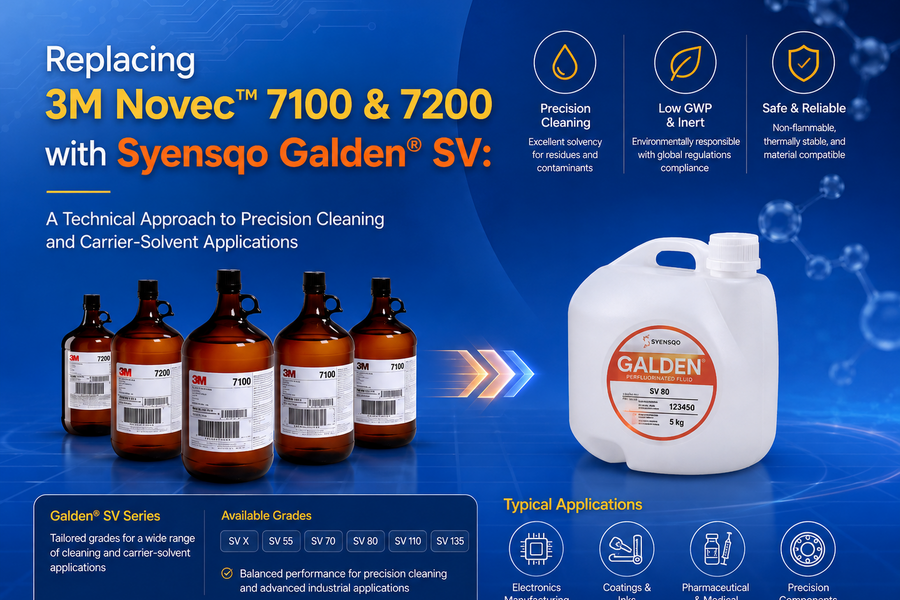
1. The Novec Phase-Out and the Need for Alternative Fluids
The transition away 3M Novec fluids has created a significant qualification challenge for manufacturers using fluorinated solvents in precision cleaning, electronics processing, and specialty lubrication.
3M announced that it would exit PFAS manufacturing by the end of 2025 and subsequently completed that manufacturing exit. Its current information also notes that individual product reformulation or discontinuation timelines can vary and should be confirmed through direct customer communications.
For engineers, the challenge is therefore not simply finding another fast-evaporating solvent. A replacement must reproduce the process function required by the application:
- low surface tension;
- controlled evaporation;
- low residue;
- material compatibility;
- electrical insulation;
- safe handling;
- suitable thermal characteristics; and
- compatibility with the contamination being removed.
This is where Galden SV becomes a technically relevant alternative.
2. Galden SV vs. Novec 7100 and 7200
Novec 7100 and 7200 were widely used because of their low surface tension and relatively low boiling points. 3M's published data lists boiling points of 61°C for Novec 7100 and 76°C for Novec 7200, with both having a surface tension of approximately 13.6 dyn/cm.
Galden SV uses a fundamentally different chemistry. Syensqo describes it as a low-molecular-weight PFPE solvent family, with grades spanning approximately 55–135°C boiling points.
| Property | Novec 7100 | Novec 7200 | Galden SV |
|---|---|---|---|
| Chemistry | HFE | HFE | PFPE |
| Boiling point | 61°C | 76°C | Approx. 55–135°C, grade dependent |
| Surface tension | 13.6 dyn/cm | 13.6 dyn/cm | Grade dependent |
| Flash point | None | None | No flash/fire/auto-ignition points stated by Syensqo |
| ODP | 0 | 0 | 0 |
| Dielectric properties | High | High | Dielectric properties |
| Material compatibility | Application dependent | Application dependent | Metals, many elastomers, rubbers and plastics |
| PFPE lubricant miscibility | Not the primary design purpose | Not the primary design purpose | Fully miscible with PFPE oils/greases |
The important engineering point is that Galden SV should not be selected solely because its boiling point resembles Novec 7100 or 7200. Grade selection must consider the entire cleaning process.
3. Why Galden SV Is Relevant to Precision Cleaning
Low Surface Tension and Micro-Gap Penetration
Precision cleaning frequently involves components containing narrow clearances, recessed features, delicate contacts, optical surfaces, or complex geometries.
A low-surface-tension liquid can improve wetting and penetration small features. This is one reason fluorinated fluids have historically been attractive for precision cleaning.
Galden SV is specifically positioned by Syensqo for cleaning operations involving solvents that may be applied to hot components, heated before application, or pressure-sprayed.
Low Residue and Spot-Free Drying
For semiconductor, optics, medical-device, and aerospace components, the drying stage is as important as the cleaning stage. Residual solvent or non-volatile contamination can compromise subsequent bonding, coating, assembly, optical performance, or electrical reliability.
Galden PFPE fluids are characterized by chemical inertness, and Syensqo notes that Galden PFPE fluids used in applications such as leak testing do not leave a residue.
For a production cleaning process, however, “zero residue” should be verified through the customer's own NVR, ionic contamination, particle, and surface-analysis protocols rather than assumed solely the fluid family.
4. Galden SV as a Carrier Solvent for Fomblin® PFPE
One of the strongest application-specific advantages of Galden SV is its relationship with Fomblin® PFPE lubricants.
Syensqo explicitly identifies Galden SV as a carrier for fluorinated lubricants, including Fomblin PFPE lubricants. The company also states that Galden SV fluids are fully miscible with PFPE oils and greases.
This enables an engineering process in which a PFPE lubricant can be diluted with a compatible carrier to achieve controlled application of a thin lubricant layer.
A typical process concept is:
- the appropriate Fomblin PFPE lubricant.
- a compatible Galden SV grade.
- Prepare the required concentration.
- Apply by dipping, spraying, dispensing, or another validated process.
- Allow the carrier solvent to evaporate.
- Verify lubricant distribution and final film performance.
The carrier's purpose is not to become part of the final lubricant film. Its role is to provide controlled transport and deposition of the PFPE lubricant.
This is particularly relevant to precision mechanisms, optical assemblies, semiconductor equipment, and microelectronic components where excessive lubricant quantity can be as problematic as insufficient lubrication.
5. Safety, Environmental and Material Compatibility Considerations
Syensqo states that Galden SV fluids are non-flammable, non-toxic, chemically inert and zero ODP. The company also states that the fluids contain no CFCs, chlorine, bromine, or iodine and are compatible with metals and a wide range of rubbers, elastomers, and plastics.
These characteristics are important for production environments where solvent exposure to sensitive components must be minimized.
Galden SV also provides dielectric properties, making the chemistry relevant to microelectronics cleaning where electrical insulation and low interaction with electronic materials are important considerations.
However, material compatibility is never universal. Process engineers should qualify the exact substrate, adhesive, coating, polymer, elastomer, and seal materials used in their equipment.
6. Engineering Recommendations for Converting Novec
A conversion should be managed as a controlled process change rather than a simple solvent substitution.
Before implementation, engineers should evaluate:
- Boiling point: an SV grade compatible with the existing heating and condensation system.
- Evaporation kinetics: Confirm drying time and vapor recovery performance.
- Solvency: Test actual contaminants rather than relying only on chemical-family assumptions.
- Material compatibility: Test polymers, elastomers, seals, adhesives and coatings.
- Cleaning efficiency: Measure particle, organic residue, ionic contamination and NVR.
- Equipment: Verify heaters, condensers, pumps, seals and vapor-control systems.
- Process validation: Establish acceptance criteria before production conversion.
The Galden SV portfolio provides several boiling-point options, which can be useful when adapting an existing process to a different thermal window.
7. Frequently Asked Questions
Can Galden SV directly replace Novec 7100 or 7200?
Not automatically. Galden SV is PFPE whereas Novec 7100/7200 are HFEs. A replacement should be qualified against boiling point, solvency, evaporation, materials compatibility and equipment conditions.
Why is Galden SV suitable for Fomblin PFPE lubricant application?
Because Syensqo specifically identifies Galden SV as a carrier for fluorinated lubricants and states that it is fully miscible with PFPE oils and greases.
Does Galden SV corrode microelectronics or plastics?
Syensqo describes Galden SV as chemically inert and compatible with metals and a wide range of elastomers and plastics. Nevertheless, each production material combination should be validated experimentally.
What makes Galden SV useful for spot-free cleaning?
Its low-molecular-weight PFPE chemistry, low surface tension, volatility, chemical inertness and low-residue characteristics make it suitable for precision cleaning applications. Actual spot-free performance must still be verified under the specific process conditions.
Is Galden SV non-flammable?
Yes. Syensqo states that Galden SV fluids have no flash, fire, or auto-ignition points.
Does Galden SV have zero ODP?
Yes. Syensqo states that Galden SV has Zero Ozone Depletion Potential (Zero ODP).
Conclusion
For manufacturers moving away 3M Novec 7100 and 7200, Syensqo Galden SV provides a technically credible PFPE-based platform for precision cleaning and carrier-solvent applications. Its combination of low-molecular-weight PFPE chemistry, chemical inertness, non-flammability, zero ODP, material compatibility and compatibility with Fomblin PFPE lubricants makes it particularly relevant to semiconductor, microelectronics, medical-device and aerospace manufacturing.
The key engineering principle is to treat Galden SV as a process-specific alternative, not an assumed one-to-one drop-in replacement. Proper grade selection and validation of cleaning efficacy, drying behavior, residue, material compatibility and equipment performance are essential for a reliable transition.
Technical References
- Syensqo — Galden® PFPE Applications
- Syensqo — Galden® SV 55
- Syensqo — Galden® SV 135
- 3M — Novec™ 7100 Technical Data
- 3M — Novec™ 7200 Technical Data
- 3M — PFAS Stewardship / PFAS Manufacturing Exit
Contact information
Hotline / WhatsApp: +84 945 261 931
Email: Sales@hicotech.com.vn

AAdministratorsQTV
Welcome. Feel free to leave a comment, we will respond soon