
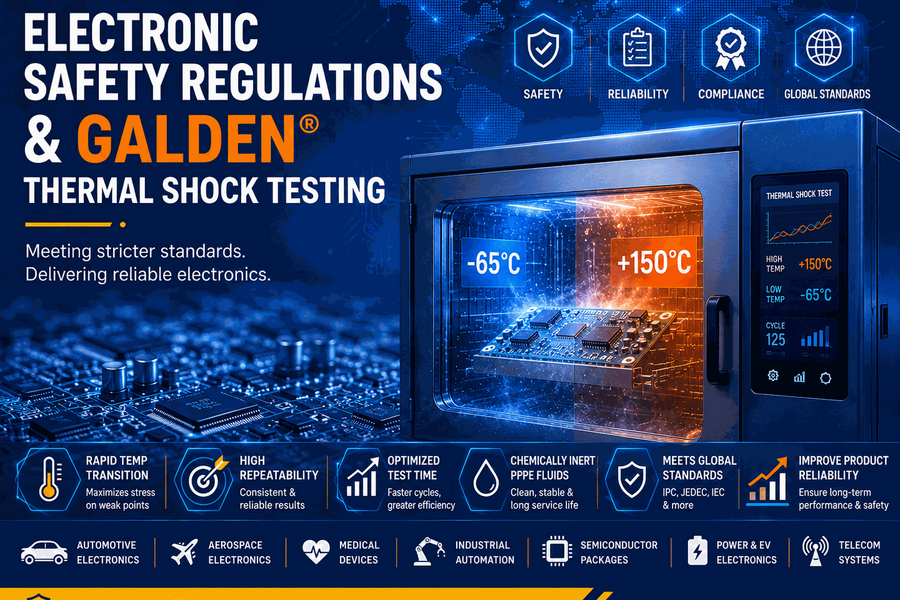
Why are regulations regarding electronic security becoming increasingly stringent?
Modern electronic products are expected to operate reliably in increasingly harsh environments. Electric vehicles experience rapid temperature fluctuations between charging and operation. Aerospace electronics must withstand extreme environmental conditions. Medical equipment demands extremely high operational reliability, while industrial automation systems often operate continuously in extreme temperatures.
Simultaneously, electronic component assemblies have become significantly more complex. Higher component density, smaller component pin packages, Ball Grid Array (BGA) devices, system-in-package (SiP) technology, and advanced semiconductor packaging all increase vulnerability to thermomechanical stress.
Repeated temperature changes cause expansion and contraction within the various materials used in electronic component assemblies. Because materials have different coefficients of thermal expansion (CTE), thermal stress builds up over time, which can lead to:
- Weld fatigue
- PCB peeling
- The welds are cracked.
- Breaking down the component package.
- Wire connection error
- Microscopic cracks inside the semiconductor packaging.
- Power outage
To address these risks, international standards organizations such as IPC , JEDEC , and IEC have established validation procedures designed to assess the reliability of electronic equipment under harsh environmental conditions. Automotive manufacturers also require suppliers to conduct rigorous environmental reliability testing before approving products for production.
Therefore, manufacturers are increasingly demanding test methods capable of producing highly repeatable thermal shocks with minimal temperature variation. This need has driven the wider adoption of fluid-based thermal shock systems using Galden® fluids.
What is a heat shock test?
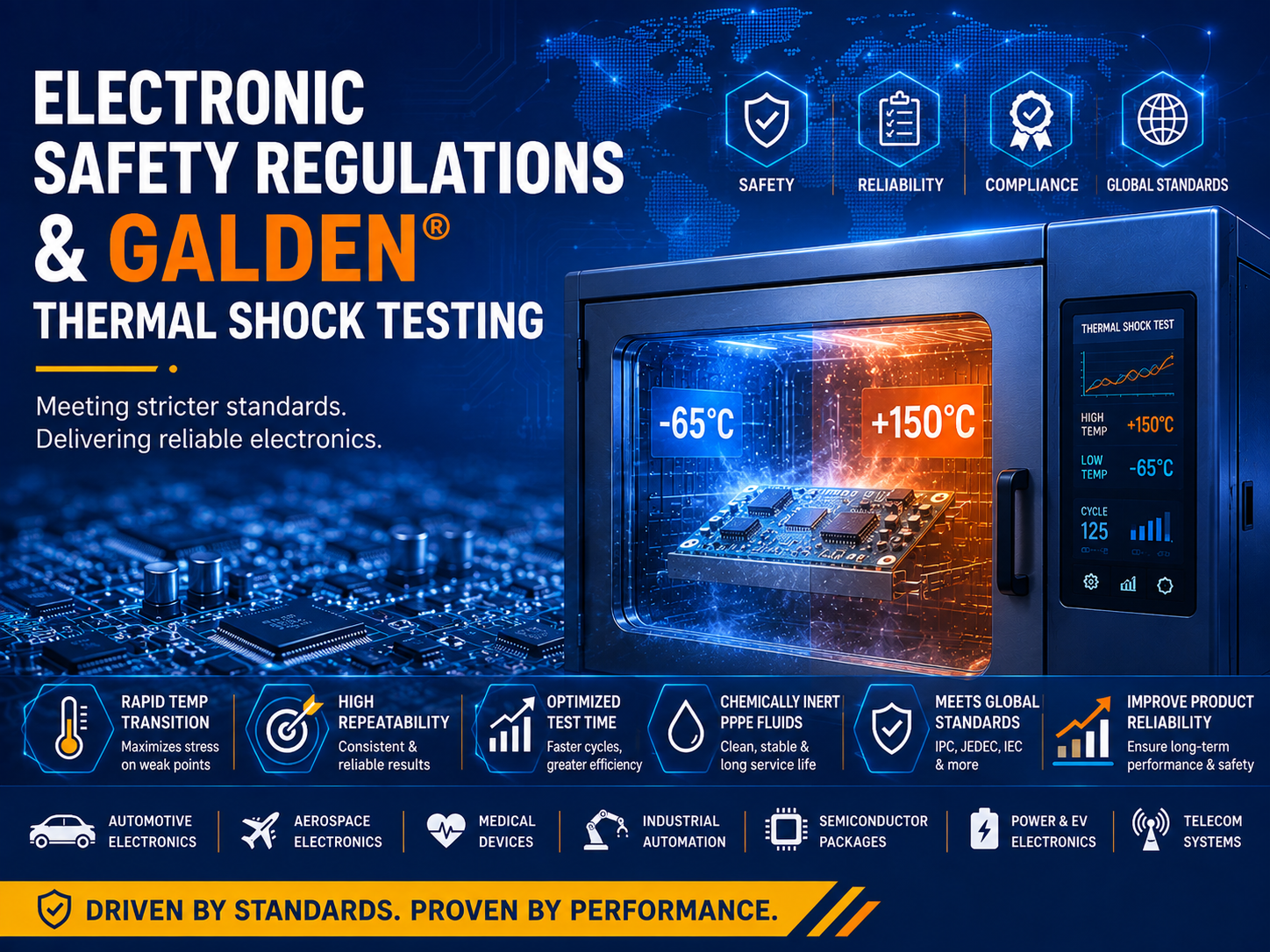
Thermal shock testing is an accelerated environmental reliability test designed to assess the ability of electronic products to withstand rapid changes between extreme temperatures.
Unlike conventional thermal cycling, where temperature changes gradually over time, thermal shock testing subjects components to near-instantaneous transitions between hot and cold environments. These rapid transitions create significant mechanical stress, accelerating potential failure mechanisms.
Typical objectives include:
- Check the reliability of the weld.
- Assessing the integrity of the packaging
- Material incompatibility detection
- Assess the long-term durability of the product.
- Identify manufacturing defects before production begins.
Typical characteristics of heat shock can range from:
- -65°C to +150°C
- -55°C to +125°C
- -40°C to +150°C
Depending on the type of product and quality standards.
The thermal shock test differs from the thermal cycling test in several important respects.
| Thermal cycle | Heatstroke |
|---|---|
| Increase the temperature gradually. | Rapid temperature conversion |
| Heating/cooling the air | Transfer liquid or fast transfer into the chamber |
| Reduce thermal stress | Higher thermal stress |
| Long-term service simulation | Accelerate failure mechanisms |
| The inspection time is longer. | Qualify faster |
The purpose of thermal shock testing is not to unnecessarily damage the product, but rather to accelerate actual failure mechanisms under controlled laboratory conditions. This allows manufacturers to improve product durability before mass production.
Why are more and more factories switching to Galden® D/DET solution?
The increasing use of Galden® D and Galden® DET solutions is primarily due to their ability to improve the consistency, reliability, and repeatability of tests.
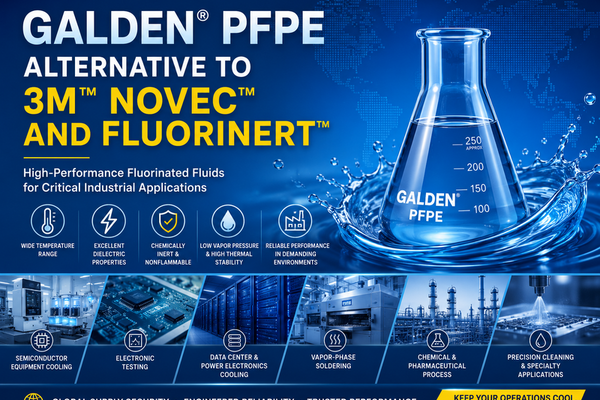
Galden® products belong to the line of fully fluorinated synthetic fluids (PFPE). According to Syensqo's technical documentation, these fluids exhibit superior chemical and thermal stability while remaining non-conductive and non-flammable.
Several characteristics make Galden® particularly suitable for applications subject to thermal shock.
stable boiling point
Each Galden® product is manufactured with precisely controlled boiling temperatures. This stability allows for precise temperature control throughout repeated test cycles and minimizes fluctuations that could affect test results.
Excellent heat transfer performance
Liquid cooling methods offer significantly higher heat transfer efficiency compared to air cooling. Components quickly reach their target temperatures with improved uniformity, minimizing temperature variations within complex electronic assemblies.
Uniform heat transfer improves repeatability between samples and minimizes measurement errors.
PFPE is chemically inert.
Galden® liquid products have extremely low chemical reactivity.
They usually don't react to:
- Metal
- Ceramics
- Glass
- Most types of engineering plastics
- Electronic packaging materials
This chemical inertness helps preserve both the test equipment and the electronic components throughout repeated testing cycles.
Insulation
Because Galden® solutions are dielectric, electronic components can be immersed in them without causing short circuits during testing. This characteristic makes them suitable for many reliability assessment systems where sensitive electronic components are exposed to the test environment.
Reduce pollution
Galden® fluids have very low impurity content and excellent chemical stability. Unlike conventional oils or other heat transfer fluids, they leave minimal residue and have low evaporation losses when properly maintained.
Reducing pollution contributes to:
- Cleaner test chamber
- Lower maintenance requirements
- More stable performance in the long term.
- Improve the reproducibility of quality assessment data.
Long service life
PFPE materials have very high resistance to oxidation and thermal degradation.
Because the fluid maintains its properties over extended operating periods, laboratories can achieve stable performance while reducing the frequency of fluid changes and downtime for maintenance.
Excellent repeatability
Perhaps the greatest advantage of the Galden® test method is its repeatability.
Modern electronic quality control increasingly relies on generating reliable data that can be reproduced across multiple laboratories and production sites. Stable fluid temperature, consistent heat transfer, and minimal fluid degradation help reduce variability between individual tests.
Although standards rarely name Galden®, manufacturers are increasingly using Galden® fluids because they offer a practical method for meeting stringent reliability testing objectives with greater reliability.
Updated safety standards have led to stricter inspection requirements.
International reliability standards continue to evolve in parallel with advances in electronic technology.
Organizations such as IPC, JEDEC, and IEC regularly validate methods to reflect modern semiconductor packaging technology, lead-free soldering systems, and increasingly demanding operating environments.
For example, JEDEC's environmental stress standards and IPC's reliability guidelines emphasize the importance of accelerated testing capable of identifying potential manufacturing defects before the product reaches the customer.
The widespread adoption of lead-free solder has further increased interest in thermal shock testing. Compared with traditional tin-lead alloys, lead-free solder joints generally operate at higher processing temperatures and may experience different fatigue behaviors under thermal stress. Manufacturers therefore place greater emphasis on validating solder joint reliability during qualification.
Automotive electronics represent another significant driver. Electronic control units (ECUs), battery management systems, ADAS modules, and power electronics must withstand repeated thermal excursions throughout vehicle life. Qualification programs often incorporate severe environmental testing to ensure reliable operation over many years.
Medical and aerospace sectors impose similarly demanding expectations. Devices operating in life-support systems, aircraft electronics, satellites, or mission-critical industrial equipment require exceptionally consistent reliability data.
In response, quality laboratories increasingly prefer liquid-based thermal shock systems using Galden® fluids because they provide better temperature uniformity, faster stabilization, and more repeatable environmental exposure than conventional air-based approaches.
Galden® D/DET vs Traditional Air Thermal Shock Chambers
| Factor | Traditional Air Chamber | Galden® D/DET Liquid System |
| Heat transfer efficiency | Moderate | Very high |
| Temperature uniformity | Good | Excellent |
| Transition speed | Slower | Rapid |
| Repeatability | Moderate | Excellent |
| Temperature gradients | Larger | Minimal |
| Test duration | Longer | Typically shorter |
| Risk of oxidation | Higher at elevated temperatures | Lower due to inert PFPE fluid |
| Maintenance stability | Depends on chamber condition | Stable with proper fluid management |
| Reliability of qualification data | Good | Highly consistent |
While air chambers remain suitable for many qualification programs, Galden®-based liquid thermal shock systems offer significant advantages when precise temperature control, rapid transitions, and highly repeatable reliability testing are required.
Typical Applications
Galden® thermal shock testing is widely used throughout the electronics manufacturing industry, including:
- Printed circuit board (PCB) assemblies
- SMT production qualification
- Ball Grid Array (BGA) packages
- Semiconductor devices
- Automotive ECUs
- Battery management systems
- Power modules
- IGBT and SiC power electronics
- Sensors and MEMS devices
- RF communication modules
- Connectors and cable assemblies
- Aerospace electronic systems
- Medical electronic equipment
- Industrial automation controllers
As electronics continue to increase in complexity and reliability expectations become more demanding, thermal shock testing remains an essential tool for validating product performance before mass production and field deployment.
Frequently Asked Questions (FAQ)
Is Galden® required by IPC or JEDEC standards?
No. International standards specify performance and quality requirements, but do not mandate the use of a specific type of heat transfer fluid. Manufacturers choose Galden® because it allows for highly repeatable thermal shock testing.
Why is Galden® preferred over air in some thermal shock protection systems?
Galden® offers faster heat transfer, better temperature uniformity, and reduced variability during testing, resulting in more consistent quality assessment data.
Are Galden® materials electrically conductive?
No. Galden® PFPE liquid is a dielectric, therefore it is suitable for immersion thermal testing of electronic components.
Can Galden® damage electronic components?
Under normal operating conditions and with the selection of appropriate solutions, Galden® is chemically inert to most metals, ceramics, glass, and many engineering materials commonly used in the electronics industry.
Which industries would benefit most from Galden® thermal shock testing?
Manufacturers in the automotive, aerospace, semiconductor, medical device, industrial automation, telecommunications, and power electronics industries frequently utilize Galden®-based systems.
Why is repeatability important in heat shock testing?
Repeat testing helps reduce discrepancies between laboratories, enhances the reliability of quality assessment data, and supports consistent quality control throughout product development and manufacturing.
Conclusion
As electronic products become increasingly compact, robust, and demandingly safe, manufacturers face growing pressure to demonstrate long-term reliability through rigorous environmental testing processes. While international standards do not mandate the use of Galden® fluids, the need for accurate, repeatable, and efficient thermal shock testing has driven many organizations to adopt fluid-based systems utilizing Galden® D and Galden® DET . Their stable PFPE chemical composition, excellent heat transfer properties, dielectric properties, and long service life make them highly suitable for demanding reliability testing in the automotive, aerospace, semiconductor, medical, and industrial electronics sectors.
For organizations seeking to improve their environmental quality assessment processes or evaluate genuine Syensqo Galden® solutions , Hicotech Vietnam Co., Ltd. provides technical consulting, application support, and genuine Galden® products to help manufacturers achieve reliable, repeatable, and compliant thermal shock test results.
Contact information
Hotline / WhatsApp: +84 945 261 931
Email: Sales@hicotech.com.vn
AAdministratorsQTV
Welcome. Feel free to leave a comment, we will respond soon