
News
20
Aug
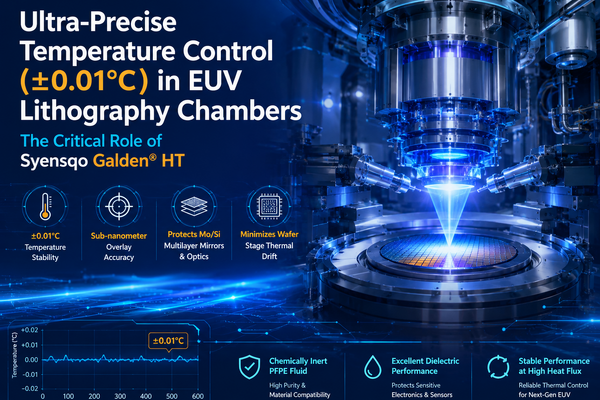
Ultra-Precise Temperature Control (±0.01°C) in EUV Lithography Chambers: The Critical Role of Syensqo Galden® HT
Syensqo Galden® HT is a PFPE-based dielectric heat-transfer fluid designed for demanding semiconductor thermal-management applications. Its chemical inertness, low viscosity, low evaporation, high dielectric strength, and thermal stability make it suitable for precision cooling systems used around sensitive EUV lithography equipment.
By providing stable and uniform heat removal, Galden® HT helps control temperature variation (ΔT), thermal gradients (∇T), and thermal drift in optical components and wafer-stage assemblies. When integrated with precision chillers and closed-loop temperature control, it can support highly stable thermal conditions required for advanced EUV lithography and sub-nanometer process control.
14
Aug
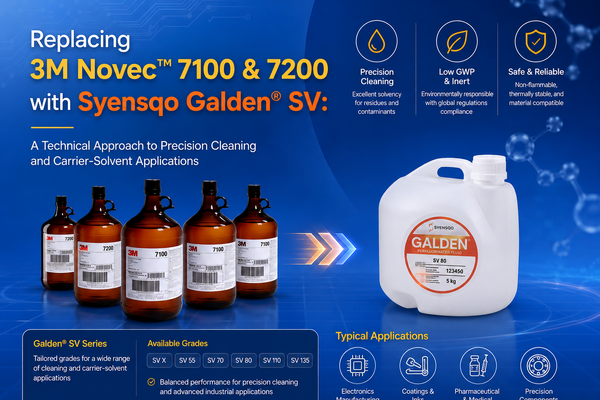
Replacing 3M Novec 7100 & 7200 with Syensqo Galden® SV: A Technical Approach to Precision Cleaning and Carrier-Solvent Applications
This article examines Syensqo Galden® SV as an alternative to 3M Novec™ 7100 and 7200 for precision cleaning and carrier-solvent applications. It compares key technical factors including boiling point, surface tension, evaporation behavior, chemical inertness, material compatibility, dielectric properties, residue performance, and environmental characteristics. The article also explains how Galden SV can be used as a carrier solvent for Fomblin® PFPE lubricants, supporting controlled, uniform deposition of thin lubricant films. For engineers transitioning Novec fluids, it provides practical recommendations for evaluating equipment compatibility, cleaning performance, drying behavior, and process validation before implementation.

13
Aug
REACH 2026 PFAS Regulation: Why Does Galden® PFPE Remain a Compliant Choice?
The EU’s proposed PFAS restriction under REACH has raised concerns among industrial manufacturers about the future compliance of high-performance PFPE fluids such as Galden®. However, a broad PFAS classification does not mean that every fluorinated material is automatically prohibited. Galden® PFPE has a distinct chemical structure and highly inert properties that differentiate it restricted legacy PFAS such as PFOA and PFOS. This article explains the current REACH regulatory landscape, the distinction between PFAS classification and regulatory status, and the key compliance factors industrial users should consider when continuing to use Galden® PFPE.
04
Aug
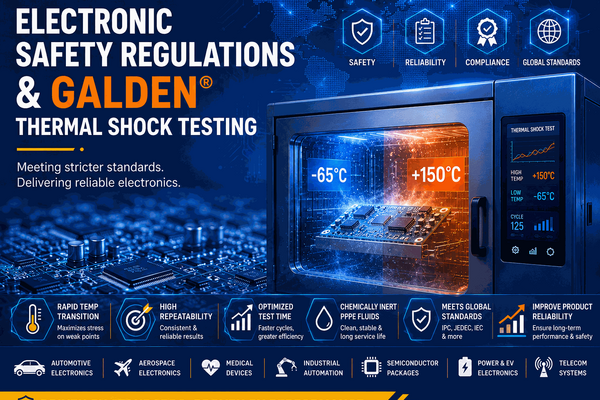
Electronic Safety Regulations: Why Are Electronics Manufacturers Switching to Galden® Thermal Shock Testing?
As electronic devices become smaller, more powerful, and increasingly deployed in safety-critical applications, manufacturers face growing pressure to demonstrate long-term product reliability. Industries such as automotive electronics, aerospace, medical devices, telecommunications, industrial automation, and power electronics are all subject to stricter reliability expectations driven by international standards and customer qualification requirements. Although most regulations do not explicitly mandate the use of a specific heat transfer medium, they increasingly require manufacturers to prove that electronic assemblies can withstand severe thermal stress throughout their service life.
One testing method gaining widespread adoption is thermal shock testing using Galden® D and Galden® DET fluids. These perfluoropolyether (PFPE)-based fluids, developed by Syensqo, are widely used in liquid-to-liquid thermal shock systems because they provide highly stable temperature control, excellent thermal transfer efficiency, chemical inertness, and repeatable test conditions. As manufacturers pursue more reliable qualification data and lower testing variability, Galden® fluids have become an increasingly important solution for electronics reliability laboratories and quality assurance departments.
Rather than being driven solely by regulatory compliance, the growing adoption of Galden® thermal shock testing reflects the industry's need for more accurate, repeatable, and standardized reliability evaluation methods that support today's high-density electronic assemblies.
28
Jul
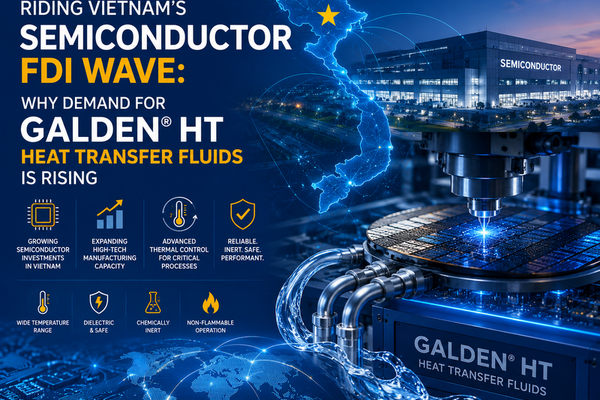
Riding Vietnam’s Semiconductor FDI Wave: Why Demand for Galden® HT Heat Transfer Fluids Is Rising
Vietnam is strengthening its position in the global semiconductor supply chain as international companies expand packaging, testing, electronics manufacturing, research and supporting technology operations in the country. This investment trend is increasing demand for advanced production infrastructure, including cleanrooms, process chillers, thermal-control units and semiconductor reliability-testing equipment. Galden® HT PFPE fluids Syensqo are used in selected systems that require a dielectric, chemically inert, non-flammable heat-transfer medium across a broad operating-temperature range. They are particularly relevant to demanding processes such as dry etching, chemical vapor deposition, physical vapor deposition and recirculating temperature-control systems. Galden HT is not universally mandatory for every semiconductor plant, but it can become an important OEM-approved process fluid where conventional water-glycol or hydrocarbon-based coolants cannot meet the required safety, compatibility or temperature specifications.

17
Jul
The AI Data Center Era: Galden® PFPE Immersion Cooling on the Data-Center Floor
Artificial intelligence is changing data-center thermal design. GPU-dense AI systems can concentrate more than 100 kW of electrical load in a single rack, creating heat levels that conventional room-based air cooling may struggle to remove efficiently. Liquid cooling therefore moves heat capture closer to the processors—through cold plates or by immersing electronic hardware in a dielectric fluid. Galden® PFPE immersion cooling fluids Syensqo provide electrical insulation, chemical inertness, thermal stability and non-flammable operation for demanding AI and high-performance computing environments. Depending on the selected grade and system architecture, Galden PFPE can support single-phase heat-transfer circuits or two-phase immersion systems. Successful implementation, however, requires careful fluid selection, materials testing, vapor containment, maintenance planning and integration with facility-level heat rejection.
16
Jul
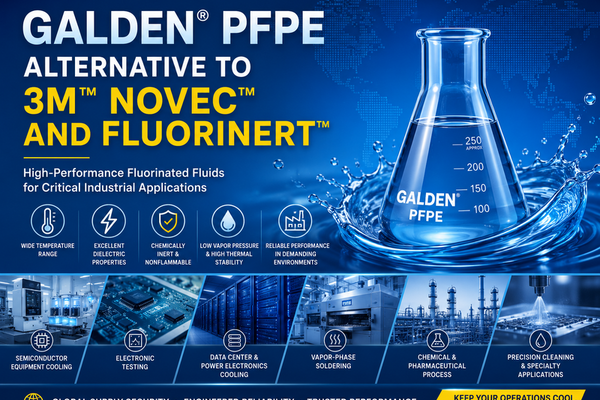
Galden® PFPE is the most suitable alternative to 3M Novec and Fluorinert.
Following the discontinuation of 3M Novec and Fluorinert fluids, Syensqo Galden® PFPE offers a strong alternative for heat transfer, electronic testing, semiconductor cooling, vapor-phase soldering, and specialized cleaning applications. Its dielectric performance, nonflammability, chemical stability, and broad temperature range make it suitable for critical industrial systems, although each conversion should be technically evaluated and validated before implementation.

10
Jul
Galden® HT PFPE Heat Transfer Fluids for Semiconductor Manufacturing
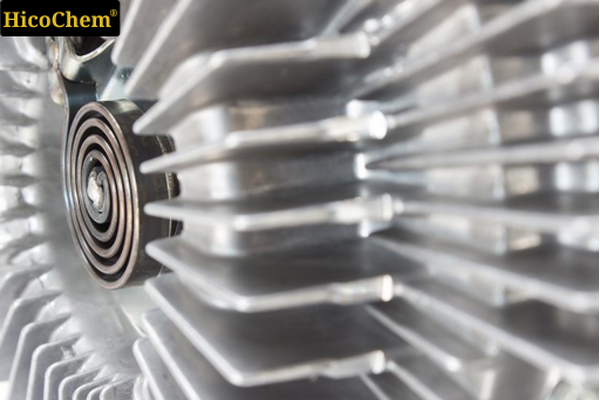
Galden HT PFPE improves semiconductor performance through stable heat transfer, electrical insulation, chemical inertness, non-flammability, low vapor pressure, low-temperature flow, and multiple boiling-point grades. Properly selected PFPE for semiconductor fabrication supports both front-end and back-end operations. It can serve chillers, wafer cooling, etching, deposition, probe testing, burn-in, thermal cycling, and packaging.
17
Apr
Galden® PFPE Fluids – Advanced High-Performance Solutions for Extreme Industrial Environments
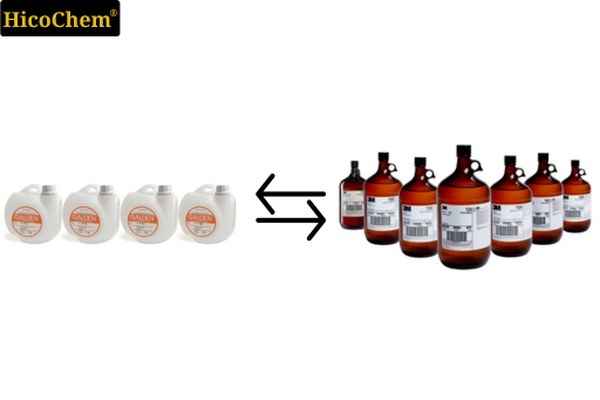
Following 3M’s announcement to phase out PFAS-based products—including Novec™ and Fluorinert™ fluids—by the end of 2025, industries are actively seeking reliable alternatives.
Syensqo’s Galden® PFPE fluids have emerged as a leading replacement solution. With comparable or superior performance characteristics, they provide a seamless transition for applications previously reliant on 3M’s fluoropolymer products.
02
Apr
Krytox™ High-Performance Lubricants For Automotive Engines And Auxiliary Systems
Krytox™ lubricants demonstrate exceptional resistance to washout and contamination, maintaining performance even in dirty or wet conditions—far outperforming conventional lubricants.