
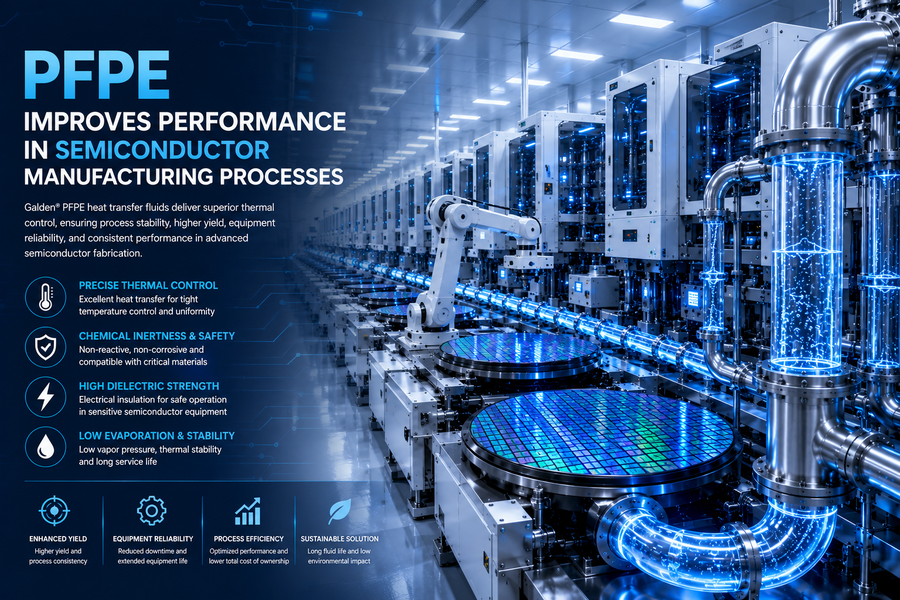
How Does PFPE Improve Performance in Semiconductor Fabrication?
Shrinking chip geometries and three-dimensional architectures require tighter temperature control across wafer tools, plasma systems, test equipment, and packaging lines. Fluid evaporation, conductivity, corrosion, or chemical reaction can increase drift, downtime, and contamination risk.
Galden® PFPE Syensqo is an inert, dielectric heat-transfer fluid family for semiconductor environments. By providing stable heat exchange across broad temperature ranges, PFPE for semiconductor fabrication supports repeatability, equipment reliability, and device quality.
Featured Snippet
How does PFPE improve semiconductor fabrication? Galden PFPE transfers heat without readily conducting electricity or reacting with aggressive chemicals. Its thermal stability, low evaporation rate, low viscosity, and broad operating range help maintain controlled temperatures, reduce fluid loss, and improve repeatability.
What Is PFPE?
PFPE means perfluoropolyether, a fully fluorinated ether-based fluid composed primarily of carbon, fluorine, and oxygen. Strong carbon–fluorine bonds resist heat, oxidation, and chemical attack.
Galden PFPE is engineered as a dielectric heat-transfer and electronic-testing medium. Key properties include:
- Chemical, thermal, and oxidative stability
- High electrical resistivity
- No flash, fire, or auto-ignition point
- Low vapor pressure and evaporation loss
- Low surface tension
- Compatibility with many metals, plastics, and elastomers
Syensqo reports Galden HT boiling points 55°C to 270°C and typical family operating temperatures approximately −70°C to 290°C, depending on grade and system conditions. hermal Control Determine Semiconductor Performance?
Temperature influences reaction rate, plasma behavior, film formation, dimensional stability, and measured electrical performance. Variations at a wafer chuck or test interface can alter etch profiles, deposition uniformity, endpoint control, or test results.
Therefore, PFPE for semiconductor fabrication supports:
- Wafer and chuck-temperature regulation
- Dry etching and plasma operations
- CVD and PVD deposition
- Probe, burn-in, and thermal-shock testing
- Packaging and reliability qualification
Constant temperature is especially important when wafers must remain defect-free and equipment operates with aggressive gases or elevated process temperatures. alden PFPE Improve Each Process Step?
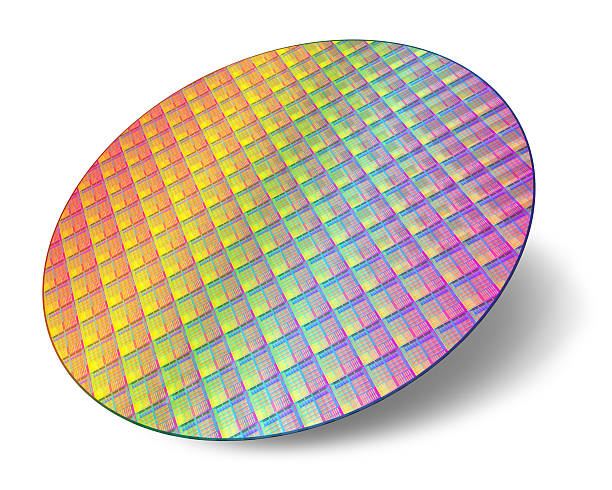
A silicon wafer used to manufacture microchips.
| Process step | Galden PFPE role | Main benefit |
|---|---|---|
| Wafer cooling | Circulates through temperature-control units | Limits chuck-temperature drift |
| Dry etching and plasma | Removes heat through qualified chiller loops | Supports repeatable etch conditions |
| CVD and PVD | Manages deposition-support temperatures | Limits excursions, pressure buildup, cavitation, and loss |
| CMP support | Controls approved auxiliary cooling loops | Stabilizes equipment temperature; it is not polishing slurry |
| Probe and testing | Controls wafer or device temperature | Improves hot and cold test repeatability |
| Burn-in and cycling | Provides dielectric heat transfer | Enables uniform thermal stress |
| Packaging and VPS | Transfers heat by vapor condensation | Promotes uniform component heating |
| Advanced packaging | Supports cycling and qualification | Improves temperature uniformity |
Syensqo identifies Galden HT for semiconductor chillers, dry etching, CVD, PVD, probe temperature control, electronic testing, and vapor-phase soldering. Thus, PFPE for semiconductor fabrication is relevant front-end processing to back-end qualification. nical Properties Create the Advantage?
| Property | Engineering value |
| Broad boiling-point range | Matches grade to the required thermal window |
| Low viscosity and pour point | Supports circulation during cold testing |
| Chemical inertness | Reduces reaction risk |
| High dielectric strength | Protects qualified energized systems |
| Low surface tension | Improves surface wetting |
| Low vapor pressure | Limits vapor generation and fluid loss |
| Thermal stability | Supports high-temperature service |
| Non-flammability | Reduces fire risk |
| Material compatibility | Supports common construction materials |
| Grade-specific purity control | Supports contamination-sensitive systems when verified by TDS and CoA |
Family-level include dielectric strength of 40 kV at 2.54 mm and volume resistivity near 1.5 × 10^15 ohm·cm. Use of PFPE for semiconductor fabrication must follow the relevant technical data sheet and compatibility testing with installed seals, hoses, gaskets, and operating cycles. FPE for Semiconductor Fabrication Used?
Common applications include:
- Wafer-cooling plates and electrostatic-chuck chiller circuits
- Recirculating chillers and temperature-control units
- Dry-etch, plasma, CVD, and PVD thermal loops
- CMP equipment cooling where tool-approved
- Wafer probing and semiconductor testing
- Direct immersion cooling and testing
- Liquid burn-in, thermal shock, and thermal cycling
- Hermeticity and leak testing with suitable grades
- Vapor-phase soldering and advanced-package qualification
For EUV lithography, Galden PFPE belongs only in OEM-qualified thermal-control subsystems. This is an engineering inference the dielectric, low-vapor-pressure chiller properties of PFPE for semiconductor fabrication, not a universal tool specification. Cleanliness, pressure, materials, and grade still require OEM validation. its Does a Semiconductor Fab Gain?
Properly specified PFPE for semiconductor fabrication can provide:
- Stable process and test temperatures
- Lower evaporation-related consumption
- Reduced corrosion and reaction risk
- Electrical insulation near sensitive components
- Reliable operation across broad temperatures
- Better etch, deposition, and test repeatability
- Longer service intervals under controlled conditions
These benefits explain the role of PFPE for semiconductor fabrication, but they do not replace filtration, leak prevention, moisture control, fluid analysis, or OEM-approved materials. den PFPE Widely Used in Semiconductors?
Galden PFPE combines dielectric strength, chemical inertness, non-flammability, low vapor pressure, low-temperature mobility, and high-temperature stability. Multiple HT and testing grades allow PFPE for semiconductor fabrication to be selected for a defined thermal duty rather than forcing one grade every process.
The result is predictable thermal management where contamination, conduction, fire, or chemical reaction could affect yield and equipment availability.
Asked Questions
1. What is PFPE?
PFPE is perfluoropolyether, a fully fluorinated fluid chemistry valued for stability, inertness, dielectric performance, and non-flammability.
2. What is Galden PFPE used for?
It is used in semiconductor heat transfer, chillers, wafer-temperature control, electronic testing, burn-in, thermal shock, and vapor-phase soldering. FPE conduct electricity?
Galden PFPE is dielectric and highly resistive, supporting qualified cooling and testing near energized components. den PFPE flammable?
No. Syensqo states that Galden PFPE has no flash, fire, or auto-ignition point. lden PFPE cool wafers?
Yes. Suitable grades are used in approved semiconductor chiller and temperature-control loops. lden PFPE Be Used in EUV Equipment?
It may suit qualified thermal-control subsystems, but EUV use is equipment-specific and requires validation by the tool manufacturer.
7. How Does PFPE Differ Silicone Oil?
Galden PFPE is fully fluorinated, chemically inert, dielectric, and non-flammable. Silicone-fluid properties vary by formulation, so substitution requires thermal, electrical, contamination, and compatibility analysis.
8. Why Use PFPE in Semiconductor Manufacturing?
PFPE for semiconductor fabrication provides precise thermal control while limiting electrical, chemical, fire, corrosion, and evaporation risks.
Conclusion
Galden PFPE makes thermal control stable, electrically insulating, and adaptable across fabrication, testing, and packaging. Its grade range supports wafer cooling, plasma processing, deposition, probing, burn-in, thermal cycling, and advanced packaging.
The correct grade must be selected temperature range, boiling point, viscosity, vapor pressure, construction materials, and OEM specifications. With disciplined system design, PFPE for semiconductor fabrication supports repeatability, uptime, and quality.
Contact Information
Hotline / Zalo: 0945 261 931
Email: sales@hicotech.com.vn
WhatsApp: +84 945 261 931


AAdministratorsQTV
Welcome. Feel free to leave a comment, we will respond soon