

Introduction
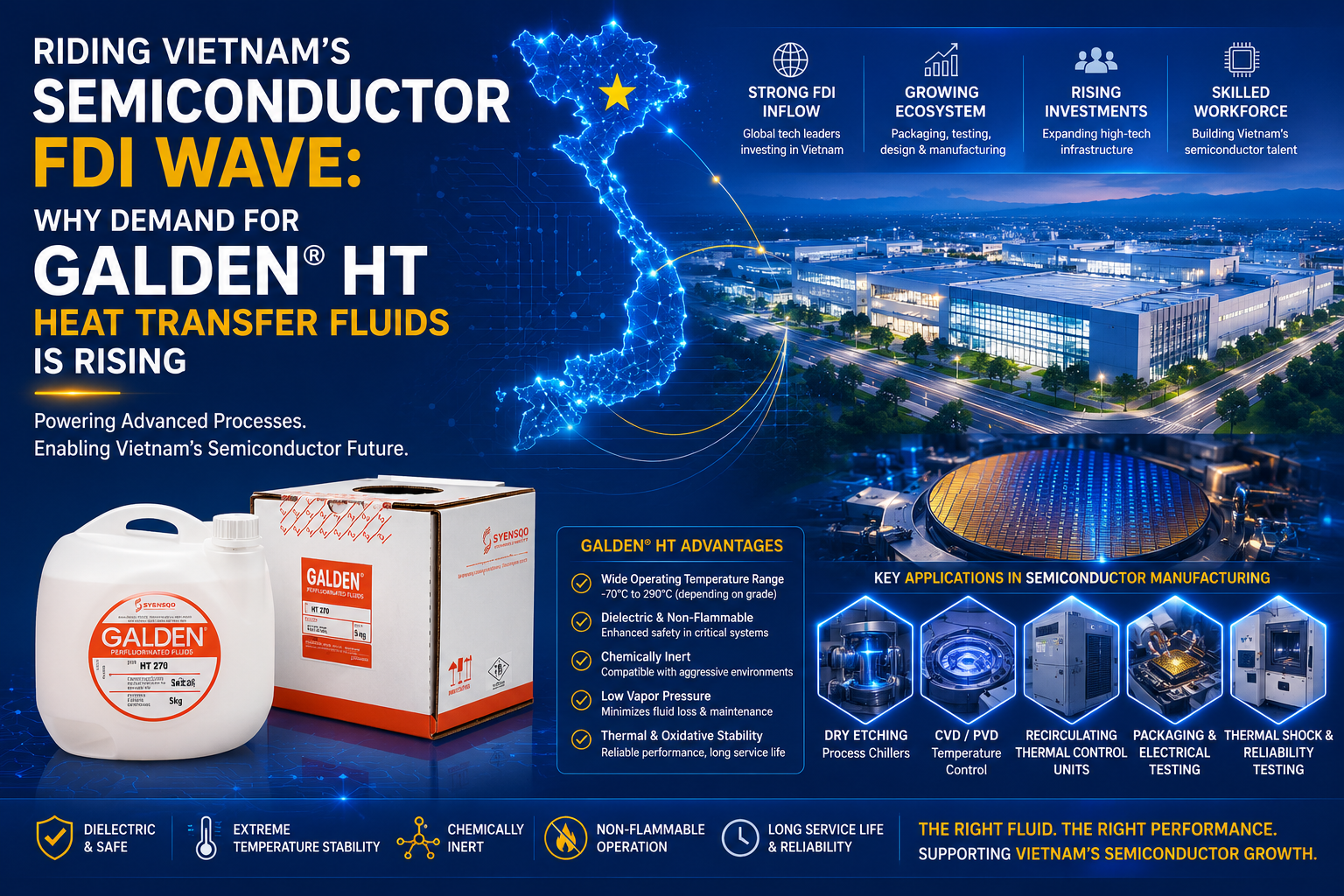
Vietnam’s semiconductor opportunity is moving beyond general electronics assembly. The country is actively developing capabilities in integrated-circuit design, semiconductor packaging, electrical testing, supporting materials and, over the longer term, wafer fabrication.
Under Decision No. 1018/QD-TTg, Vietnam’s semiconductor strategy for 2024–2030 aims to selectively attract foreign direct investment, establish at least 100 chip-design companies, develop one small-scale semiconductor manufacturing facility, operate 10 packaging and testing plants, and build a workforce of more than 50,000 semiconductor engineers and graduates.
Commercial investments are already supporting this direction. Example: Amkor Technology inaugurated its advanced semiconductor packaging facility in Bac Ninh with a planned investment of $1.6 billion and approximately 200,000 square metres of cleanroom space. NVIDIA also established its first Vietnam research and development centre in 2024, although this is an AI software and research operation rather than a semiconductor fabrication plant. Together, these developments illustrate the broadening of Vietnam’s high-technology ecosystem.
As more advanced equipment is installed, the market will require not only buildings and machinery, but also qualified process materials. One of these categories is high-performance semiconductor heat-transfer fluid.
Why Semiconductor FDI Is Increasing Demand for Thermal-Control Fluids
Semiconductor processes depend on precise and repeatable temperature control. Even relatively small temperature deviations can influence plasma stability, etch rate, deposition uniformity, wafer stress, dimensional control and test repeatability.
New semiconductor investments therefore create demand for:
- Process chillers and temperature-control units
- Heat exchangers and recirculating thermal loops
- Wafer-processing and chamber-temperature systems
- Package burn-in and reliability-testing equipment
- Thermal-shock and hermetic-seal test systems
- Maintenance fluids, filters, seals and fluid-analysis services
The demand does not arise simply because a new factory has opened. It depends on the types of tools installed, the temperature ranges specified by the equipment manufacturer and the chemical environments surrounding the thermal circuit.
Packaging and testing plants may require fluids for thermal cycling, burn-in, device qualification and process-equipment cooling. Future wafer-fabrication investments would create additional requirements in etching, deposition, cleaning and other tightly controlled processes.
What Is Galden® HT PFPE Heat Transfer Fluid?
Galden® HT is a family of perfluoropolyether, or PFPE, heat-transfer fluids developed for demanding industrial and semiconductor thermal-control systems.
Syensqo describes Galden HT fluids as inert, dielectric and non-flammable, with boiling points ranging approximately 55°C to 270°C. Selected grades can support end-use temperatures of up to approximately 290°C, subject to the individual product specification and system design. The portfolio enables engineers to choose a fluid according to the required operating temperature, viscosity, vapor pressure and evaporation-loss profile.
Key characteristics include:
| Galden® HT characteristic | Process relevance |
|---|---|
| Dielectric properties | Reduces electrical-conduction risk in suitable equipment and sensitive electronic environments |
| Chemical inertness | Helps resist reactions with process chemicals and common construction materials |
| Broad temperature portfolio | Supports low-, moderate- and high-temperature thermal-control applications |
| No flash or fire point | Reduces flammability concerns compared with many hydrocarbon-based fluids |
| Low vapor pressure in selected grades | Helps limit evaporation losses in correctly designed closed systems |
| Low-temperature viscosity performance | Supports circulation and temperature response at reduced operating temperatures |
| Thermal and oxidative stability | Helps maintain fluid performance during extended service |
Syensqo identifies semiconductor production, recirculating chillers, electronic testing and other high-technology processes as established application areas for Galden PFPE fluids.
Is Galden HT Mandatory in Semiconductor Manufacturing?
Galden HT is not legally or universally mandatory for every semiconductor facility in Vietnam.
Semiconductor equipment normally requires an OEM-approved heat-transfer fluid that meets defined specifications for temperature range, viscosity, electrical properties, material compatibility, purity and safety. Depending on the tool, an approved fluid may be PFPE-based, water-glycol-based or another engineered coolant.
Galden HT becomes particularly relevant when the application requires a combination of:
- Electrical insulation
- Non-flammable operation
- Chemical inertness
- Low-temperature pumpability
- High-temperature stability
- Compatibility with aggressive semiconductor environments
- Reduced risk of deposits caused by fluid degradation
Substitution should never be based only on boiling point. Engineers must verify the equipment manual, seal materials, pump design, heater watt density, operating pressure and warranty conditions before changing fluids.
Why Galden® HT Supports Advanced Semiconductor Processes
Stable process-temperature control
Wafer quality depends on maintaining controlled and constant temperatures. Syensqo specifically notes that temperature stability is vital to keeping wafers free process-related defects.
The availability of multiple Galden HT grades allows the thermal fluid to be matched more closely to the process window. This can support faster temperature response, stable circulation and appropriate vapor-pressure control.
Resistance to aggressive environments
Semiconductor tools may operate near plasma, reactive gases, strong cleaning chemicals and vacuum-processing systems. Galden PFPE’s chemical inertness can reduce the likelihood of unwanted fluid reactions, corrosion-related contamination and degradation residues when the system is correctly designed and maintained.
Dielectric and non-flammable performance
Water-based fluids offer excellent heat-transfer efficiency, but leakage near electrical assemblies can create conductivity and corrosion concerns. Some hydrocarbon fluids provide electrical insulation but introduce flash-point and fire-management considerations.
Galden HT combines dielectric behavior with the absence of flash, fire and auto-ignition points reported by Syensqo. This does not eliminate the need for ventilation, leak control or risk assessment, but it can provide an important safety advantage in high-value semiconductor equipment.
Common applications include:
Dry-etch process chillers
Dry etching requires controlled chamber and wafer temperatures to maintain plasma-process repeatability, profile control and etch uniformity.
CVD and PVD equipment
Chemical and physical vapor deposition processes require stable thermal conditions to support consistent film thickness, adhesion and material properties.
Recirculating temperature-control units
Galden HT may be used in closed-loop chillers serving semiconductor tools, test equipment or other systems where dielectric performance and a broad temperature range are required.
Semiconductor packaging and electrical testing
Packaging and testing facilities may use qualified dielectric fluids for temperature cycling, device testing and other controlled thermal operations.
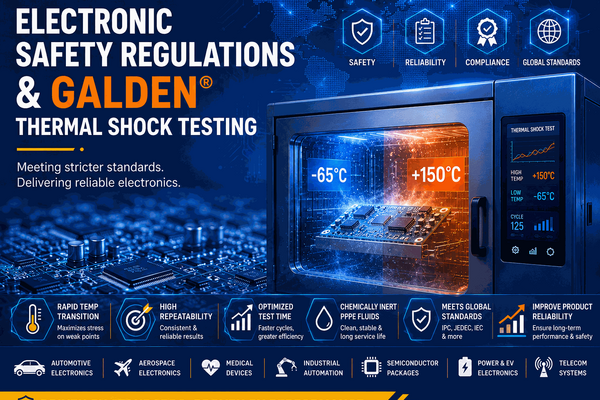
Thermal-shock and hermetic-seal testing
Different Galden product families are available for electronic reliability testing. Galden D grades are generally associated with thermal-shock and hermetic-seal testing, while Galden HT is intended primarily for heat-transfer circuits. Galden LS/HS fluids are specifically formulated for vapor-phase soldering. These families should not be treated as interchangeable.
Galden HT Compared with Conventional Heat Transfer Fluids
| Selection factor | Galden® HT PFPE | Water-glycol coolant | Hydrocarbon or silicone fluid |
| Electrical behavior | Dielectric | Electrically conductive when contaminated or ion-rich | Often electrically insulating |
| Flammability | No reported flash or fire point | Generally low flammability | Depends strongly on formulation |
| Heat capacity | Lower than water-based systems | Typically high | Generally moderate |
| Chemical inertness | Very high | Requires corrosion and chemistry control | Varies by formulation |
| Temperature range | Broad, grade-dependent | Limited by freezing, boiling and pressure | Product-dependent |
| Evaporation management | Low in correctly selected grades | Normally low in sealed loops | Product-dependent |
| Initial fluid cost | Relatively high | Lower | Moderate to high |
| Best-fit use | Aggressive, dielectric or specialized temperature-control systems | General industrial cooling with isolated electrical systems | Applications approved for the specific formulation |
Galden HT should therefore be selected according to total lifecycle performance rather than purchase price alone. Fluid consumption, downtime, maintenance, contamination risk, equipment value and process yield may be more important than the initial cost per kilogram.
Frequently Asked Questions
1. Will Vietnam’s semiconductor FDI automatically increase Galden HT consumption?
Not automatically. Demand will depend on the number and type of semiconductor tools installed and whether their thermal systems specify PFPE or another compatible dielectric fluid.
2. Which Galden HT grade should a factory select?
Selection depends on operating temperature, boiling point, viscosity, vapor pressure, pump requirements and the equipment manufacturer’s approved-fluid list. A technical review is required before ordering.
3. Can Galden HT replace water-glycol coolant directly?
Usually not as a simple drop-in replacement. PFPE fluids have different density, heat capacity, viscosity and sealing requirements. Pumps, heaters, flow rates and heat exchangers must be assessed.
4. Is Galden HT suitable for dry-etch chillers?
Yes, Galden PFPE is used in semiconductor dry-etch thermal-control applications where its grade and properties match the chiller and tool specifications.
Conclusion
Vietnam’s semiconductor FDI wave is creating a broader market for cleanroom infrastructure, advanced manufacturing equipment and specialized process materials. Growth in packaging, testing, research and future wafer-processing capacity will increase the need for reliable thermal-control systems.
Galden® HT PFPE fluids are not required in every semiconductor tool, but they provide a strong technical option where dielectric performance, chemical inertness, non-flammability and operation across demanding temperatures are essential. Early fluid qualification can help investors and equipment operators avoid incompatible substitutions, unstable temperature control and unplanned downtime.
Hicotech Vietnam Co., Ltd. supplies genuine Syensqo Galden® solutions and provides technical consultation for semiconductor chillers, electronics manufacturing equipment, thermal testing and advanced heat-transfer applications. Manufacturers, equipment integrators and maintenance teams are invited to contact Hicotech for grade selection, system compatibility review and application-specific support.
Contact Information
Hotline / WhatsApp: +84 945 261 931
Email: Sales@hicotech.com.vn

AAdministratorsQTV
Welcome. Feel free to leave a comment, we will respond soon