
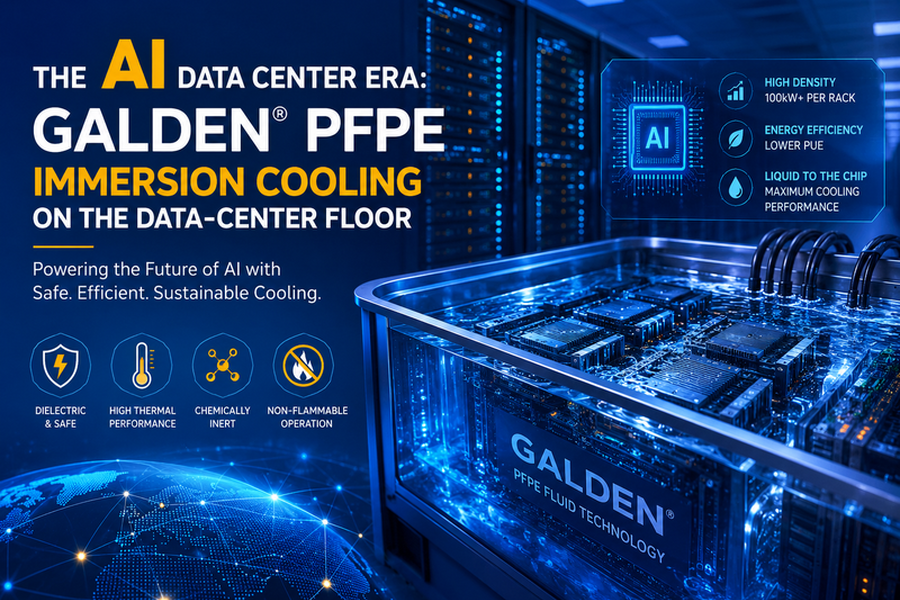
The AI Data Center Era: Galden® PFPE Immersion Cooling on the Data-Center Floor
Introduction
AI training, inference and high-performance computing are increasing both processor heat flux and rack-level power density. NVIDIA documentation, for example, identifies approximately 120 kW of power consumption for a GB200 NVL72 rack, illustrating how far AI infrastructure has moved beyond traditional enterprise racks.
This trend is changing the location of cooling. Instead of relying mainly on computer-room air-conditioning units to transport heat across the data hall, operators are bringing thermal management directly onto the data-center floor—at the chip, server, rack or immersion-tank level.
ASHRAE advises against cooling high-density AI clusters above approximately 50 kW per rack solely with air. Its guidance recommends density-based cooling architectures and liquid cooling for high-density AI and HPC deployments.
Within this transition, Galden PFPE immersion cooling offers a technically differentiated dielectric-fluid option for servers, accelerators, power electronics and other energized components.

What Is Immersion Cooling for AI Data Centers?
Immersion cooling removes heat by placing electronic assemblies directly in an electrically insulating liquid. The fluid contacts processors, memory, circuit boards and other components, eliminating several thermal resistances associated with heatsinks, fans and air gaps.
Two principal architectures are used.
Single-phase immersion cooling
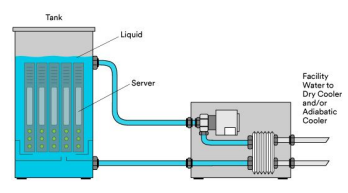
In a single-phase system, the dielectric fluid remains liquid during normal operation. Heat is transported through natural or pumped circulation to a heat exchanger or coolant distribution unit.
The immersion fluid should have:
- A boiling point safely above operating and fault temperatures
- Low viscosity for effective circulation
- Suitable specific heat and thermal conductivity
- Low vapor pressure
- Long-term compatibility with electronic materials
The Open Compute Project recommends a sea-level boiling point of at least 155°C for single-phase immersion liquids, including an altitude-related safety margin.
Two-phase immersion cooling
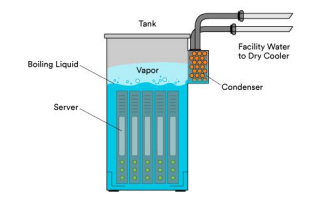
In a two-phase system, heat electronic components causes the dielectric fluid to boil locally. The vapor rises to a condenser, returns to liquid form and flows back the tank.
This phase-change process uses the fluid’s latent heat of vaporization and can remove high heat flux with relatively small temperature differences. OCP guidance identifies approximately 45–55°C as the preferred boiling range for two-phase immersion fluids, balancing component temperatures, condensation requirements and facility energy consumption.
Why Galden® PFPE Fluids Support AI Cooling Performance
Galden is a family of perfluoropolyether fluids developed for heat transfer, electronics testing, semiconductor processing and other demanding thermal applications.
Syensqo describes Galden PFPE fluids as chemically inert, dielectric and thermally stable, with boiling points approximately 55°C to 270°C and typical operating capability –70°C to 290°C, depending on the grade and application. The fluids have no flash, fire or auto-ignition points under the manufacturer’s reported test conditions.
Electrical insulation
A dielectric fluid can contact energized circuit boards without creating the short-circuit risk associated with water-based coolants. This enables direct heat removal GPUs, CPUs, voltage regulators, memory devices and other components.
Electrical properties must nevertheless be verified throughout the fluid’s service life. Contamination by water, flux residues, cleaning agents, particles or incompatible materials can change dielectric performance.
Chemical and thermal stability
PFPE chemistry provides strong resistance to oxidation and many aggressive chemicals. Syensqo also reports compatibility with a range of metals, plastics and elastomers.
Actual server qualification remains essential. Compatibility testing should include:
- Cable jackets and connector materials
- Printed-circuit-board laminates
- Adhesives, labels and thermal-interface materials
- Seals, gaskets and elastomers
- Optical components and storage devices
OCP notes that boiling point, material compatibility and equipment reliability are major fluid-selection factors, particularly because the thermal performance of candidate two-phase fluids may be relatively similar.
Grade-specific boiling points
Galden’s broad boiling-point portfolio allows engineers to a fluid for the intended architecture rather than adapting the cooling system around a single fluid temperature.
Lower-boiling grades may be considered for validated two-phase immersion systems, while higher-boiling grades may be evaluated for single-phase circulation, cold-plate secondary loops or specialized heat-transfer equipment. Selection must be based on the relevant technical data sheet, operating pressure, altitude, condenser temperature and maximum component junction temperature.
Non-flammable operation
Hydrocarbon-based immersion oils may require additional fire-risk analysis because they can have measurable flash and auto-ignition temperatures. Galden PFPE’s non-flammable behavior can simplify certain aspects of risk management, although it does not eliminate the need for leak detection, ventilation, pressure control, electrical safety or emergency procedures.
Syensqo introduced an updated portfolio for two-phase immersion cooling in April 2026, specifically targeting AI, HPC, edge-computing and data-center applications.
Typical Applications in AI and Electronics Infrastructure
Galden PFPE immersion cooling may be evaluated for:
- GPU and AI training clusters
- High-performance computing servers
- Edge-computing systems in dusty or space-constrained locations
- High-density power-conversion equipment
- Telecommunications and 5G infrastructure
- Electronic reliability testing
- Semiconductor-process thermal-control systems
- Supercomputer and recirculating-chiller applications
The Open Compute Project is developing specifications, reference designs and best practices covering immersion tanks, dielectric fluids, coolant distribution units, hardware compatibility, maintenance and safety.
Comparison of AI Data-Center Cooling Technologies
| Cooling method | Heat-removal approach | Key advantages | Main engineering considerations |
|---|---|---|---|
| Conventional air cooling | Fans move heat components to room air | Familiar infrastructure; easy component access | Fan energy, airflow space, noise and limited capability at extreme rack density |
| Direct-to-chip cooling | Water or another coolant flows through processor cold plates | Mature, scalable and effective for high-power CPUs and GPUs | Manifolds, quick disconnects, leak control and residual air-cooled heat |
| Single-phase immersion | Dielectric liquid circulates through a heat exchanger | Cools most server components; limited vapor-management requirements | Pumping, fluid volume, filtration and high-boiling-point selection |
| Two-phase PFPE immersion | Fluid boils at components and condenses above the bath | High heat-flux capability, uniform temperature and reduced server-fan dependence | Sealed containment, condenser design, vapor recovery and fluid-loss control |
Direct-to-chip systems have become the dominant liquid-cooling approach for many AI installations because of their maturity and compatibility with rack-based servers. However, ASHRAE notes that approximately 10–30% of rack heat may remain in components not connected to cold plates, requiring continued air cooling.
Immersion cooling can capture heat a broader portion of the server, but it requires purpose-designed or carefully qualified hardware and different maintenance procedures.
Frequently Asked Questions
Is Galden PFPE used for single-phase or two-phase immersion cooling?
Potentially both, depending on the grade and validated system design. Low-boiling fluids are associated with two-phase operation, while high-boiling grades may remain liquid in single-phase systems.
Can standard servers be placed directly Galden fluid?
Not automatically. Fans, hard drives, labels, adhesives, thermal materials, cables and connectors must be assessed. Server warranties and manufacturer approval should also be reviewed.
Does immersion cooling eliminate all data-center air conditioning?
Not necessarily. Network equipment, power supplies, room electronics and personnel areas may still require air conditioning. Facility heat rejection is also still necessary.
Does Galden PFPE conduct electricity?
Galden products are formulated as dielectric fluids. However, dielectric strength can be affected by contamination, moisture or degradation products, so periodic fluid analysis is recommended.
Is PFPE immersion fluid flammable?
Syensqo reports that Galden PFPE fluids have no flash, fire or auto-ignition points under standard test conditions. Site-specific safety assessments remain mandatory.
How is the correct boiling point selected?
Engineers must consider component temperature limits, facility-water temperature, condenser approach temperature, altitude, tank pressure, vapor pressure and anticipated fluid losses.
Can immersion cooling improve PUE?
It can reduce server-fan power and mechanical cooling demand, but actual PUE depends on the complete system, including pumps, condensers, CDUs and heat-rejection equipment. Performance should be measured rather than assumed.
What maintenance does an immersion system require?
Typical tasks include fluid sampling, contamination control, condenser inspection, leak detection, filter maintenance, fluid-level monitoring and verification of seals and material compatibility.
Conclusion
The AI data-center era requires cooling systems designed around processor heat flux and rack density the beginning of the project. Galden PFPE immersion cooling brings heat removal directly to energized electronics while providing dielectric behavior, non-flammability, chemical inertness and a broad selection of boiling points.
The fluid alone, however, does not determine system success. Engineers must qualify materials, the correct Galden grade, manage vapor and fluid inventory, design reliable heat rejection and establish safe maintenance procedures.
Hicotech Vietnam Co., Ltd. provides technical consultation and genuine Syensqo Galden® solutions for AI data centers, electronic manufacturing, semiconductor processes and high-performance heat-transfer systems. Contact Hicotech’s technical team for fluid selection, compatibility assessment and application support.
Contact Information
Hotline / WhatsApp: +84 945 261 931
Email: Sales@hicotech.com.vn

AAdministratorsQTV
Welcome. Feel free to leave a comment, we will respond soon