

- Client Duong Do dinh - (0986490xxx) bought 8 month ago (25/11/2025)
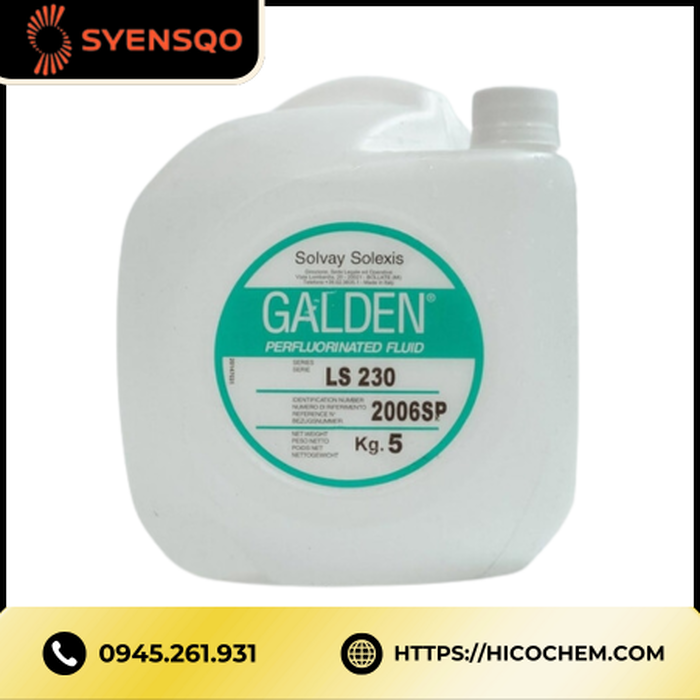
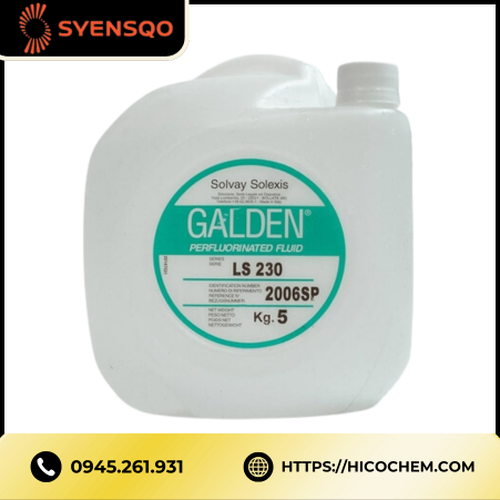
Galden® LS 230 - Vapor Phase Soldering Fluid
4 5 (1 evaluate)Category: Galden® LS/HS
Maker: Syensqo
Made in: Italy
Packaging: 1kg, 5kg
What Is Galden® LS 230?
Galden® LS 230 is a fully fluorinated perfluoropolyether fluid specifically engineered for Vapor Phase Soldering, also known as condensation soldering. Its narrow molecular-weight distribution and controlled vapor behavior help maintain a stable soldering temperature during repeated production cycles.
Galden® LS 230 is primarily selected for lead-free soldering processes whose validated reflow profile is compatible with a 230°C vapor environment. It should not be confused with Galden® HT 230: although both products have a nominal temperature of 230°C, LS 230 is specifically controlled for Vapor Phase Soldering, whereas HT 230 is a general heat-transfer fluid.
Key Features and Process Benefits
| Feature | Process and Customer Benefit |
|---|---|
| Controlled vapor temperature of 230°C | Establishes a predictable thermal ceiling for compatible lead-free soldering profiles and reduces uncontrolled temperature overshoot. |
| Narrow molecular-weight distribution | Supports stable vapor temperature, repeatable production profiles and minimal boiling-point drift. |
| Uniform condensation heating | Transfers heat across small components, large connectors, shielded areas and complex PCB geometries. |
| Low heat of vaporization | Enables efficient heat transfer and rapid process response during reflow. |
| Vapor density greater than air | Creates a protective vapor environment around the assembly and limits oxygen exposure during heating. |
| Excellent thermal and chemical stability | Helps maintain fluid performance during repeated high-temperature production cycles. |
| Non-flammable PFPE composition | Has no flash point, fire point or auto-ignition point under standard test conditions. |
| Low residue formation | Supports clean drying and helps reduce decomposition deposits inside the VPS chamber. |
| Good material compatibility | Reduces the risk of corrosion or reaction with compatible equipment construction materials. |
| Strong dielectric performance | Provides electrical insulation suitable for electronics-manufacturing environments. |
| Low vapor pressure at room temperature | Helps reduce fluid losses during idle periods when the VPS system is properly sealed and maintained. |
| RoHS-compatible VPS fluid family | Supports lead-free electronics-manufacturing processes at vapor temperatures up to 260°C across the LS/HS range. |
These features are identified in Syensqo’s current Galden® product information and in the Galden® LS/HS technical bulletin, which highlights process repeatability, absence of boiling-point drift, residue-free drying, inert-atmosphere heating and enhanced high-temperature safety.
Technical Properties
The following values are typical properties at 25°C unless otherwise specified. They are intended for grade comparison and preliminary process evaluation, not as guaranteed acceptance specifications.
| Property | Typical Value |
|---|---|
| Chemical family | PFPE |
| Physical form | Clear liquid |
| Boiling point / nominal vapor temperature | 230°C |
| Density at 25°C | 1.82 g/cm³ |
| Kinematic viscosity at 25°C | 4.40 cSt |
| Vapor pressure at 25°C | 3.4 Pa |
| Specific heat at 25°C | 973 J/kg·°C |
| Heat of vaporization at boiling point | 63 J/g |
| Thermal conductivity at 25°C | 0.07 W/m·°C |
| Coefficient of thermal expansion | 0.0011 cm³/cm³·°C |
| Surface tension | 20 dyne/cm |
| Dielectric strength | 40 kV at a 2.54 mm gap |
| Dielectric constant | 2.1 |
| Volume resistivity | 1 × 10¹⁵ Ω·cm |
| Average molecular weight | 1,020 amu |
| Flash, fire and auto-ignition points | None under standard tests |
Important: The published room-temperature vapor pressure is 3.4 Pa, not 3.4 torr. Temperature Reflux Vapor, or TRV, and distillation range should also be checked in the current product specification because these parameters are critical for LS/HS Vapor Phase Soldering fluids.
Galden® LS/HS Series Comparison
The principal difference among Galden® LS and HS grades is their controlled vapor temperature. Grade selection should be based primarily on the solder alloy, solder-paste reflow window, component-temperature limits and VPS machine design.
| Grade | Vapor Temperature | Density at 25°C | Viscosity at 25°C | Vapor Pressure at 25°C | Typical Selection Profile |
|---|---|---|---|---|---|
| Galden® LS 200 | 200°C | 1.79 g/cm³ | 2.50 cSt | 21 Pa | Tin-lead and compatible low-temperature solder profiles |
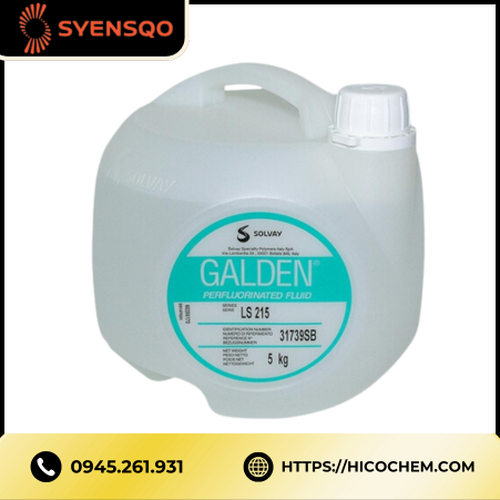
| Galden® LS 215 | 215°C | 1.80 g/cm³ | 3.80 cSt | 12 Pa | Lower-temperature or specially qualified lead-free profiles |
| Galden® LS 230 | 230°C | 1.82 g/cm³ | 4.40 cSt | 3.4 Pa | Compatible mainstream lead-free PCB reflow |
| Galden® HS 240 | 240°C | 1.82 g/cm³ | 5.30 cSt | 1 Pa | Lead-free processes requiring additional thermal margin |
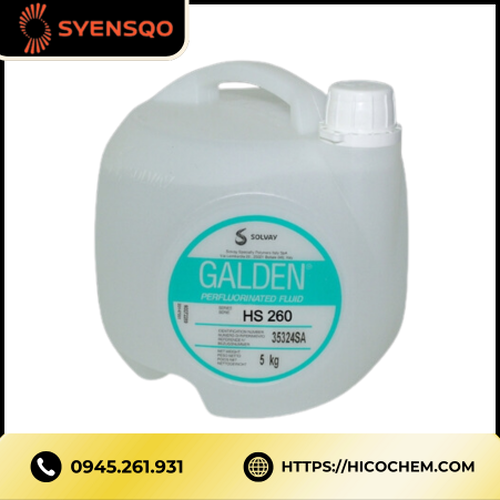
| Galden® HS 260 | 260°C | 1.83 g/cm³ | 7.00 cSt | 1 Pa | Specialized high-temperature soldering processes |
The comparison values come from the Galden® LS/HS Vapor Phase Soldering technical bulletin.
LS 230 Compared with LS 215
Galden® LS 230 provides a vapor temperature approximately 15°C higher than LS 215. It offers more thermal margin for solder pastes that cannot complete reflow in a 215°C vapor environment, but it also exposes the assembly to a higher maximum process temperature.
LS 230 Compared with HS 240
Galden® LS 230 limits the saturated vapor temperature to approximately 230°C, while HS 240 provides a 240°C vapor zone. HS 240 may be appropriate when additional process margin is required, but LS 230 may reduce thermal stress on temperature-sensitive components, connectors and PCB laminates.
LS 230 Compared with HT 230
Galden® LS 230 and HT 230 are not automatically interchangeable. LS 230 is controlled for narrow molecular-weight distribution, distillation range and Temperature Reflux Vapor. Galden® HT 230 is formulated primarily as a circulating heat-transfer fluid and uses different product-control parameters.
Common Applications
1. Lead-Free SMT Vapor Phase Reflow
Galden® LS 230 is primarily used as the working fluid in VPS equipment processing lead-free printed circuit board assemblies. Its controlled 230°C vapor zone can support solder pastes whose approved peak-temperature and time-above-liquidus requirements fit within this thermal window.
2. Complex and Densely Populated PCB Assemblies
Condensation vapor can surround tall components, connectors, shielding structures and densely packed devices. This makes LS 230 particularly suitable for assemblies where directional hot-air flow may produce thermal shadowing or uneven heating.
Because the vapor condenses on surfaces that remain cooler than the vapor temperature, heat is distributed across exposed areas regardless of component orientation. This application benefit is an engineering consequence of the condensation-heating mechanism described by Syensqo.
3. Mixed-Thermal-Mass Assemblies
PCB assemblies may contain both lightweight surface-mount components and high-mass parts such as transformers, copper planes, power connectors or heat spreaders.
Uniform condensation heating helps reduce temperature differences between low- and high-thermal-mass areas. This can simplify profile development and support more consistent solder-joint formation across the assembly.
4. Power Electronics and High-Current Assemblies
Galden® LS 230 can be considered for compatible power-electronics assemblies containing heavy copper boards, power semiconductors, large terminals and thermally demanding substrates.
The uniform heating mechanism can be useful where large differences in component mass make conventional convection reflow difficult to balance. The completed reflow profile must still comply with the solder-paste, component and substrate suppliers’ thermal limits.
5. Prototype, NPI and High-Mix Production
VPS is well suited to prototype development, new-product introduction and high-mix manufacturing because the maximum vapor-zone temperature is determined primarily by the selected fluid.
Different compatible board layouts can often be processed without creating an entirely new set of convection-zone temperatures for each product. Machine parameters such as preheating, immersion time, board loading and cooling must still be qualified for every assembly.
6. EMS and OEM Lead-Free Production
Galden® LS 230 can be used in Electronics Manufacturing Services and original-equipment-manufacturer production environments that require repeatable processing of compatible lead-free PCBAs.
Its narrow molecular-weight distribution and controlled vapor temperature help maintain stable process conditions across repeated production cycles.
Frequently Asked Questions About Galden® LS 230
1. What is Galden® LS 230 used for?
Galden® LS 230 is used as a PFPE working fluid in Vapor Phase Soldering machines operating at a controlled vapor temperature of approximately 230°C. Its main application is lead-free reflow soldering of compatible printed circuit board assemblies.
2. Is Galden® LS 230 suitable for lead-free soldering?
Yes. The Galden® LS/HS family is designed for lead-free VPS processing, with grades covering vapor temperatures up to 260°C. LS 230 should be used only when the selected solder paste can achieve its required liquidus time and peak profile within a 230°C vapor environment.
3. How does Galden® LS 230 prevent overheating?
The saturated vapor has a defined temperature of approximately 230°C at the specified operating pressure. Vapor condenses only on surfaces cooler than the vapor, so heat transfer decreases as the assembly approaches that temperature.
This creates a naturally limited heating environment and reduces uncontrolled temperature overshoot. It does not eliminate the need to control dwell time, preheating, board loading and cooling.
4. What is the difference between Galden® LS 230 and HS 240?
LS 230 produces an approximately 230°C vapor zone, while HS 240 produces an approximately 240°C vapor zone. LS 230 generally limits assembly exposure to a lower peak temperature, whereas HS 240 provides greater thermal margin for soldering processes that cannot be completed reliably at 230°C.
5. Can Galden® LS 230 be mixed with another LS or HS grade?
Routine mixing is not recommended without technical evaluation. Although LS and HS grades share PFPE chemistry, mixing changes the molecular-weight distribution, vapor-temperature profile and distillation range.
The resulting fluid may no longer provide the precise TRV and repeatability specified for either original grade. This is an engineering inference based on Syensqo’s requirement to control molecular-weight distribution, TRV and distillation range for VPS fluids.
6. Does Galden® LS 230 leave residue or cause corrosion?
Under recommended operating conditions, Galden® LS/HS fluids provide good material compatibility and do not normally form decomposition residues. The LS/HS technical bulletin also identifies no corrosion or reaction with compatible construction materials as a process benefit.
Abnormal overheating must be prevented. Syensqo states that significant PFPE thermal degradation begins around 290–300°C, well above the nominal LS 230 vapor temperature but potentially reachable during heater or electrical failures.
7. Is Galden® LS 230 flammable?
No. Galden® PFPE fluids have no flash point, fire point or auto-ignition point under standard test conditions. This provides an important process-safety advantage in high-temperature soldering equipment.
8. How long can Galden® LS 230 be stored?
Syensqo states that Galden® PFPE fluids remain chemically stable for more than 20 years when stored in their original sealed containers. Containers should remain closed, correctly labeled and protected from contamination.

AAdministratorsQTV
Welcome. Feel free to leave a comment, we will respond soon