
Fomblin® PFPE Lubricants: Applications, Performance, and Pressure Stability Explained
Nội dung bài viết
Where Do Fomblin® PFPE Lubricants Deliver Superior Performance?
Fomblin® PFPE lubricants are widely recognized as some of the most advanced synthetic lubricants available for demanding industrial applications. Thanks to their exceptional thermal stability, chemical inertness, non-flammability, and long service life, these high-performance lubricants are trusted across industries where conventional oils and greases often fail to provide reliable protection.
When formulated specialty greases, Fomblin® PFPE products offer outstanding lubrication performance under extreme temperatures, aggressive chemical exposure, high vacuum conditions, and critical operating environments. As a result, they are extensively used in industries such as chemical processing, electronics manufacturing, aerospace and defense, nuclear power generation, data processing, and other technologically advanced sectors.
Read more: What Is Fomblin® PFPE? Why Choose Fomblin® PFPE Lubricants?
Typical Applications of Fomblin® PFPE Lubricants
Fomblin® PFPE lubricants have demonstrated exceptional reliability in a wide variety of specialized applications, including:
-
Lubrication of tenter frame chains and bearings in textile manufacturing facilities operating at elevated temperatures.
-
Critical lubrication systems for deep-space rocket nozzles and aerospace propulsion components.
-
High-performance lubrication of missile launch and catapult systems used in defense applications.
-
Sintered metal bearings requiring extremely long operating life with minimal maintenance.
-
Precision lubrication of anti-lock braking system (ABS) components in automotive applications.
-
Oxygen, chlorine, and other reactive gas valves and pumping systems where chemical compatibility is essential.
-
Sealing and lubricating fluids for vacuum pumps operating under demanding vacuum conditions.
-
Protection and lubrication of gold-plated electrical contact surfaces to ensure long-term conductivity and reliability.
-
Specialized lubricants for equipment operating within the nuclear industry.
-
Precision instrument lubrication where cleanliness, stability, and consistency are critical.
-
Lifetime-lubricated sealed bearings designed for maintenance-free operation.
-
Lubrication of gasoline tank float mechanisms and fuel system components.
-
Bearings and mechanical assemblies exposed to high temperatures, moisture, corrosive chemicals, and harsh industrial environments.
These diverse applications demonstrate the versatility and reliability of Fomblin® PFPE technology in situations where equipment failure is not an option and long-term performance is a critical requirement.
How Does Pressure Affect the Performance of Fomblin® PFPE Lubricants?
One of the key advantages of Fomblin® PFPE lubricants is their ability to maintain excellent lubrication characteristics even when subjected to significant mechanical pressure. Unlike many conventional lubricants that may degrade or lose effectiveness under load, Fomblin® PFPE fluids remain stable and continue to provide dependable protection for moving components.
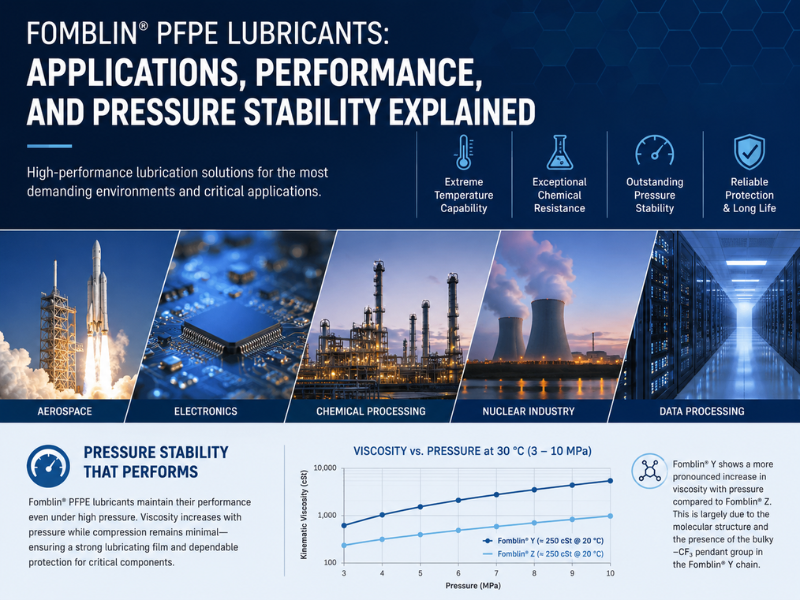
When pressure increases, Fomblin® PFPE lubricants exhibit a moderate rise in viscosity while undergoing only slight compression. This behavior contributes to the formation of a durable lubricating film capable of protecting surfaces under demanding operating conditions.
However, the pressure-viscosity response differs between the various Fomblin® product families. In particular, Fomblin® Y fluids show a more pronounced increase in viscosity under pressure than Fomblin® Z fluids. This difference is primarily attributed to their unique molecular structures, especially the presence of the bulky –CF₃ side groups within the molecular chain of Fomblin® Y.
These structural characteristics influence how the lubricant molecules respond to external forces, resulting in distinct pressure-viscosity behaviors that can be advantageous in specific applications. Understanding these differences allows engineers and equipment designers to the most appropriate PFPE lubricant for their operating conditions.
The pressure-viscosity relationship has been evaluated at 30°C across a pressure range of 3–10 MPa using Fomblin® Y and Fomblin® Z fluids with comparable viscosities of approximately 250 cSt at 20°C (68°F). The results clearly illustrate the stronger pressure dependence exhibited by Fomblin® Y compared with Fomblin® Z, highlighting the impact of molecular architecture on lubricant performance under load.
Contact Information
Hotline / WhatsApp: +84 945 261 931
Email: Sales@hicotech.com.vn
AAdministratorsQTV
Welcome. Feel free to leave a comment, we will respond soon