
Two-Phase Immersion Cooling
Nội dung bài viết
What is Two-Phase Immersion Cooling?
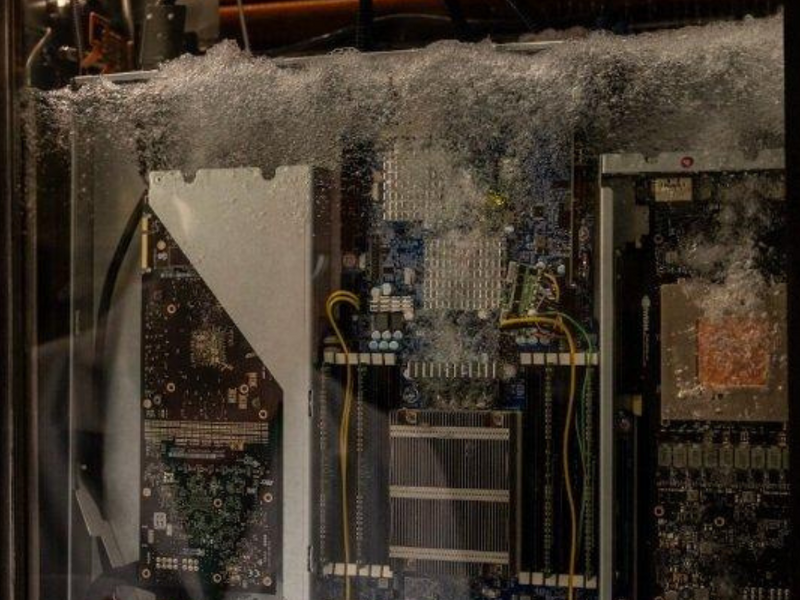
Two-phase immersion cooling represents a breakthrough in next-generation data center thermal management. By fully submerging electronic components in a dielectric heat transfer fluid, the system delivers superior heat dissipation performance far beyond traditional air, water, or oil-based cooling methods. Engineered with a low boiling point of approximately 50°C, the fluid vaporizes directly on the surface of heat-generating components, and the rising vapor naturally removes heat through passive heat transfer.
Unlike traditional oil-based immersion cooling, two-phase fluids are clean, environmentally friendly, and non-flammable. The system does not require pumps or jets to maintain cooling performance. Instead, fluid circulation occurs naturally through evaporation and condensation, without additional energy input. Compared to conventional cooling technologies, this solution significantly reduces energy consumption, enhances system reliability, and enables higher computing density-making it an ideal choice for high-performance computing (HPC), AI workloads, and future-ready data centers.
How Two-Phase Immersion Cooling Works?
Servers and other IT equipment are fully immersed in a thermally conductive dielectric coolant designed for high-efficiency heat transfer. As the fluid comes direct contact with heat-generating components, it absorbs thermal energy and initiates a low-temperature phase-change process. The liquid evaporates at the surface of hot components, effectively removing heat and carrying it away in the form of vapor.
This vapor is then cooled through a heat exchange mechanism-typically via a condenser coil-where it condenses back liquid form. The cooled fluid subsequently returns to the main reservoir, ensuring a continuous, closed-loop cooling cycle that delivers consistent and reliable thermal performance.
Key Applications of Two-Phase Immersion Cooling
- 5G & Edge Computing
.png)
The rapid rollout of 5G is driving telecom operators to expand edge computing infrastructure in order to minimize latency and enhance real-time data processing. However, edge data centers are typically deployed in space-constrained urban environments. Two-phase immersion cooling enables significantly higher computing density within limited footprints, making it an optimal solution for scalable and efficient edge deployments.
- Artificial Intelligence (AI) & Machine Learning
.png)
AI and machine learning workloads demand massive parallel processing power, often delivered through high-density GPU clusters. These systems generate substantial heat, leading to increased energy consumption when relying on traditional air cooling. Two-phase immersion cooling offers a highly efficient and sustainable alternative, reducing both operational costs and environmental impact while supporting intensive computational performance.
- Blockchain & Cryptocurrency
.png)
Blockchain and cryptocurrency networks depend on continuous verification across distributed nodes to ensure data integrity and security. As network scale and computational complexity grow, so does heat generation. Two-phase immersion cooling provides a cost-effective and environmentally responsible solution to manage thermal challenges in these high-load environments.
- High-Frequency Trading (HFT)
.png)
High-frequency trading requires ultra-low latency and high-performance computing systems to execute transactions in fractions of a second. Even millisecond delays can translate significant financial impact. Two-phase immersion cooling supports higher overclocking potential and system stability, enabling optimal performance for latency-critical trading operations.
Key Advantages of Two-Phase Immersion Cooling
- Higher Efficiency & Energy Savings
Two-phase immersion cooling delivers over 90% efficiency improvement compared to traditional air cooling, when considering both server power consumption and air conditioning requirements. This results in substantially lower energy usage and operating costs for data centers.
- Enhanced Reliability
By maintaining stable thermal conditions, components are no longer exposed to temperature fluctuations, significantly reducing the risk of failure. The elimination of cooling fans also removes mechanical vibration, minimizing wear and extending hardware lifespan.
- Greater Computing Density
Without the need for heat sinks and cooling fans, hardware can be deployed in much tighter configurations. This enables up to 10x higher computing density within the same physical footprint, maximizing data center capacity.
- Reduced Maintenance Requirements
The passive nature of two-phase immersion cooling eliminates the need for complex mechanical components. With fewer parts to maintain or replace, operational overhead is significantly reduced—especially beneficial for remote or edge deployments.
- Flexible Deployment
Free the constraints of air conditioning systems and intensive maintenance, two-phase immersion solutions can be modularized and deployed in confined spaces or harsh environments, offering unmatched flexibility for modern infrastructure.
Contact Information
Hotline / WhatsApp: +84 945 261 931
Email: Sales@hicotech.com.vn
AAdministratorsQTV
Welcome. Feel free to leave a comment, we will respond soon